|
Animal Watch, Spring/Summer 1999
Full Contents - Pages 1-16
Is the end of the Ward nigh?
Hopes are high for ban on staghunt cruelty
They're the focus of an Attorney General review, they're being investigated by the Gardaí for alleged cruelty and ICABS has now exposed their cruel brand of animal abuse. Many are hoping that this now means that the days are numbered for Meath-based Ward Union Staghounds.
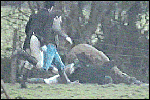
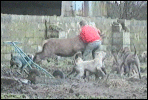
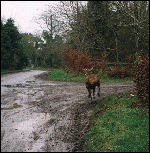
On January 19th, 1999, two ICABS observers secured the images of cruelty which would finally reveal to the Irish public the sheer cruelty of this hunt. The shocking images shown here were captured at the end of an hour and a half long chase when the exhausted stag was cornered in a field. The terrified animal, with hounds biting at its legs and body, repeatedly tried to evade capture but hunt supporters grabbed onto it in a bid to make sure that there was no way out.
|
The stag did manage to struggle away but its freedom was short-lived - a hunt member ran in, grabbed onto the animal's neck and roughly wrestled it to the ground. Other hunt supporters immediately joined in, all putting every effort into preventing the stag from escaping.
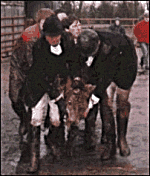
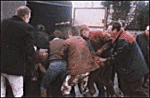
Shortly afterwards, the hunters were photographed dragging the animal through a farmyard, through three gates and finally forcing it back into the trailer from which it had been released ninety minutes earlier. An ICABS observer looked into the trailer to see the condition of the animal. The exhausted stag, with tongue hanging out and blood in its mouth, presented a shocking scene.
The public got a chance to view the horrific scenes of staghunt cruelty when RTÉ News broadcast the ICABS video footage in January. The response received at Head Office from disgusted members of the public from all over Ireland was unanimous: carted staghunting is cruel and barbaric and should be banned immediately.
ICABS is now awaiting the outcomes of a review by the Attorney General as well as a Garda investigation into alleged cruelty by the Ward Union.
|
Stags hunted by the Ward Union Staghunt are exclusively bred for hunting. Their sole purpose in life is to provide entertainment for the members of the hunt who can chase their quarry for anything up to three hours across the countryside of Meath and North County Dublin. From the Ward Union's deer park in Dunshaughlin, two stags are taken out to each hunt in a trailer. One is released while the other is kept on standby in case the first is caught too quickly or strays onto prohibited land.
You can help bring carted stag hunting to an end by contacting the relevant government ministers and demanding that they take immediate steps to halt the Ward Union Staghunt.
Minister has AG's advice on stag hunt
The Attorney General has now advised the Minister for Arts and Heritage, Síle De Valera, on the legality of the Ward Union Stag Hunt. The Minister has had this information since early March, but is keeping it close to her chest for reasons best known to herself.
ICABS has been in almost daily contact with the Minister's officials at the Department since we learned that the Attorney General had delivered his advice, but we have come up against the proverbial brick wall. The Minister, we are told, is still considering the advice and will make her decision in due course. We can not even get a time frame on this decision. However, we know that it will have to be made before the next hunting season begins in October.
At the time of Animal Watch going to press, there is still no announcement from the Minister.
Greyhound Review apologises for libelling ICABS
Financial settlement will help further anti-blood sports campaign
Following a five year legal wrangle, the Irish Greyhound Review has made an unreserved public apology to ICABS over libellous remarks which appeared in the 1993 edition of the publication.
In a recent out of court settlement, Irish Greyhound Review editor, Michael Fortune, made the apology together with a financial settlement to ICABS. We can reveal that this payment will be put to the best possible use in our campaign against the abuse of wild animals for "sport".
The libel arose in the December 1993 edition of the publication when, in an article entitled "Antis are muzzled", it was wrongly claimed that the ICABS campaign was "vicious, and varied from haybarn fires to glass thrown on coursing fields as well as filthy and threatening letter writing tactics, none of which could be proven".
In his apology, the editor said: "We accept that this statement was entirely without foundation, and unreservedly apologise to the Board of Directors, officers and supporters of the Irish Council Against Blood Sports. We fully accept also that the Irish Council Against Blood Sports' campaign activities have always been and are totally lawful and non-violent, and we regret any embarrassment or distress caused by this article."
This public apology and financial settlement is a complete vindication of ICABS campaigning tactics which have always been totally legal and peaceful.
"Why I oppose foxhunting"
by Dick Power, Agricultural Correspondent
Why do I, a farmer, oppose foxhunting and blood sports in general? In response to the many queries I received and continue to receive, I write these lines.
Quite a few septuagenarians with whom I used to associate remember my expertise with shotgun and rifle, and they remember meeting me at coursing fixtures, to which I was first introduced as a boy of nine years.
After marrying a hunting lady in the mid-Fifties, I accompanied her to hunt meets and began to take a close interest in that activity and to join her therein. For that reason I was watching the hunt from the hill on our farm on a February afternoon of the late fifties. Very clearly I saw the fox running east, just outside our boundary. To make a long story short, the hunted animal acted strangely, made a U-turn and was killed on the farm adjoining ours. I well recall the yells of one of the hunters as she urged the hounds along. To my ears they sounded like "Hip, hooray!".
Later I discovered that their victim was what in hunting jargon is called a "bagman", a fox released from a sack into covert before the arrival of hounds.
On St. Patrick's Day 1959, as I cut kale for cows, I heard the cry or tongue of hounds as the hunt approached. Having heard that a "bagman" was awaiting release for the great occasion, I left my garden and ran towards the "tally-ho", hoping to save the fleeing quarry which could have saved its life in the earth on my farm, had the creature known of its whereabouts. This fugitive also made a U-turn in a vain bid to shake off the hounds, fleeing as it did so into full view of a hunting priest who had separated from the main body of riders, leading me to think that my luck was in; that I had on my land a man of compassion who would help me in what I sought to do. How unlearned I was on that day of shamrock and harp almost forty years ago!
"Look at him!" he roared on sighting the fleeing fox. He then began to howl and caper like a savage "in a state of almost mindless sub-humanity" as a famous philosopher once said, to urge the hounds in pursuit of quarry. At that point I began to "give tongue". Quite a task it was to get him to halt. "Do you know that you are hunting a bagman?", I asked. To my astonishment he replied: "What about it? Sure, 'tis only sport anyway. Aren't they all doing it now?"
What I, a hot-tempered young man in those days said to him, I'll not set down here but I think it is true to say that the "sermon" from the saddle had a profound effect on me, making me study Church history to find out why blood sports had so many "dog-collared luminaries" - as the late Malcolm Muggeridge called them - and how a priest could defend a "sadistic pastime for the privileged" as my late friend and ex-hunt master, Robert Churchward, called it; how a priest could make such unchristian, unpriestly reply.
In his book, "These Animals of Ours", the late Fr Aloysius Roche tells us that all the early Synods and Councils imposed severe penalties on clerics who engaged in blood sports. This is outlined in the chapter headed Pagan Survivals.
Those barbarians in Holy Orders said Mass with their spurs on, their hunting daggers in their belts, their horses saddled and ready outside church. Immediately after Mass, they rode off to hunt. Do blood sports' "dog-collared luminaries" of our time know that they follow a trend set by barbarians - not shepherds but robbers, bent on their own interests? Do they know that the "tradition" to which they have wed themselves has nothing to do with Christianity, except its repudiation?
In the late 1930s when two farmer brothers ordered a hunt off their farm, they were bitterly attacked by whom my informant called a "dog-collared dalteen" who was among the hunt riders. That priest was my cousin and my namesake. Indeed, I was threatened with a "telling off" from him circa 1960. May he rest in peace.
Vatican 2 teaches as follows: "People are edified by priests whose portment reflects the sublimity of their vocation...Priests at times take part in amusements which are out of harmony with a profession of Christian virtue. Catholic people expect something better from their priests, even people who themselves may not be very proper in their own conduct. The urgent need of priests is a return to and a revival of the supernatural in their lives."
As the late Dr Jebb used to say, the tally ho teams welcome the clergyman as "an invaluable acquisition".
God gave man dominion of His creatures, did He not? The Catechism of the Catholic Church tells us that our dominion over the creatures is not absolute; that it requires a religious respect for the integrity of creation (paragraph 2415). We are also reminded of the harmony that there was between the first couple and all creation (paragraph 376).
But what of the claim that foxes kill lambs and poultry? They take dead or dying lambs it is true, but very rarely kill healthy lambs from healthy ewes. The best defence of foxes I've read was written by the farmer who won the UK Lambing Competition in 1962. From research over a period of 20 years on his own farm and ten others, involving post mortems on 200 lambs and inspection of mother ewes of missing lambs, he proved that not foxes, but bad shepherding, was the cause of lamb losses. His article was supplied to me by the late Robert Churchward, ex-hunt master turned "anti".
With foxes I have no quarrel. Without hesitation, I'll save hunted foxes from their persecutors - "dog-collared" or otherwise. "Cur me persequeris? (Why do you persecute me?)".
The hunters? Yes, they've given much trouble to me and others. The hunt is a very serious threat to the well-being of livestock and to the farmer's livelihood. The hunt has played a big part in the spread of that dreadful disease, BHU, which has caused very serious losses to farmers, hunts have been blamed for spreading brucellosis, trichinosis, sarcosystosis, etc.
For those who want a good ride on horseback there is the drag hunt in which the trail can be laid so as to keep well away from flocks, herds and slurry-covered fields. Why the reluctance to turn to it? It fails to satisfy the desire to punish a fellow creature, the desire to put death in the place of life.
Otter hunting ban imminent
The news that otter hunting looks set to be banned in Ireland was greeted with delight by ICABS. The likelihood of a ban on this horrific blood sport came following the approval by Arts and Heritage Minister, Síle DeValera, of Heritage Council recommendations.
As part of their review into the licensing of certain blood sport activities, the Heritage Council advised the Minister to delete the section in the Wildlife Act which permits otter hunting.
Taking into account "Ireland's importance for otter conservation", the Heritage Council outlined to Minister DeValera that otters are listed as "a species of community interest in need of strict protection" under a European Council Directive.
A statement from Minister DeValera's office confirmed that she "has decided to propose in the forthcoming Wildlife (Amendment) Bill that the relevant section of the Wildlife Act, 1976, under which licences may be issued, be deleted, thus copperfastening the strict protection afforded to otters".
Although no licences to hunt otter have been issued in Ireland since 1990, the approval of the Heritage Council's recommendations are considered a very significant development. As long as the relevant Wildlife Act section exists, the issuance of licences to hunt otters could, in theory, resume.
In a submission to the Heritage Council last year, ICABS criticised the government's failure to implement a ban on otter hunting, describing it as being "in direct contravention of the Berne Convention and EU Directive 92/43/EEC of 21st May 1992."
Although not addressed by the Heritage Council in its final report, ICABS also called for full protection to be given to otter habitats. The disturbance of otter habitats by mink hunters, for example, is a major concern. Terrorising mink on the same stretches of river as they previously hounded otters, these hunters continue to pose a threat to otter populations. ICABS has received disturbing reports that hunters claiming to be hunting mink are actually hunting otters and we will be pressing the Minister to look into this.
Waterford Support Group News
Due to inclement weather conditions, the St Stephen's Day 1998 meet of the Waterford Foxhounds was cancelled. As a result, a demonstration organised by the Waterford Support Group of ICABS was postponed until the following day when the hunt departed from their meeting point in Tramore.
Media coverage of the event was positive and a picture of the demonstration was featured on the front page of the local Munster Express.
For some unknown reason the riders and hunt followers changed their usual meeting point at O'Shea's Hotel and instead had their pre-hunt drink at the Majestic Hotel. The hunt did not linger long in the town and quickly departed for their day's hunting.
If you wish to let the manager of the Majestic Hotel know of your objection to the hotel providing a public display of support for the Waterford Foxhounds, write to: The Manager, Majestic Hotel, Tramore Co.Waterford. Tel: 051-381761. Fax: 051-381766
John Tierney, Chairman
Waterford Support Group, ICABS
NARGC rage over school talks
The good ol' boys at the gunslingers' club, politely known as the National Association of Regional Games Council, are mad as hell because ICABS gives talks about blood sports to schools. They're so mad that they're going to, WAIT FOR IT, "take the matter to the High Court."
If that legal challenge gets off the ground, it will be even more entertaining than the Flood Tribunal. In the meantime, they have written to the Minister for Education, complaining about us, and asking that all lobby groups be prohibited from entering schools to deliver a "one-sided message".
It was a visit to a secondary school in County Laois (by invitation) that sparked off all the incandescent indignation from NARGC. They weren't even satisfied, apparently, that representatives from the hunt were subsequently invited into the school to give their side of the argument - a move that we had no objection to because we recognise that we live in a democracy and that the young students we give talks to are wise and mature enough to make up their own minds about the issues.
Meanwhile, a group of High School Swiss students have sadly cancelled a planned summer trip to Ireland after learning that blood sports continue here.
According to a letter from their teacher published in the Irish Independent in January, the students changed their minds about visiting Ireland after some research on the Internet revealed that we are an unclean country with a litter problem and that foxhunting (which was described in the letter as "a barbarous exercise") still takes place here.
This should make the good ol' boys at NARGC even madder. Perhaps they should try taking a case to the European Court to stop kids looking at the Internet and finding things out. Incidentally, our new web site is up and running, and students at home and world-wide can find out all about blood sports in Ireland.
Aideen Yourell
Fox Dig-Out - Eyewitness Report
"The hunters are about ten metres from my house - they're digging out a fox on another man's land, ready to see it ripped to shreds.
"It must be terrible for the fox, there are ten or fifteen men with shovels at one end and forty dogs at the other end waiting to shred it. They're just about to get their kill. The dogs are around the hole about to rip the fox to shreds. There are three- to four-year-old children there and they're all watching and smiling." (Comments from an ICABS supporter as he witnessed a fox being dug out by hunters in January 1999.)
Wanted
Animal Watch readers who come across any of the following items are asked to send a copy to ICABS, PO Box 88, Mullingar, Co. Westmeath.
Thank you.
Infra-red at night - drivers' delight
A new infra-red scanner for cars is set to drastically reduce the number of animals slaughtered on roads every year.
The sensor system - to be initially available in the United States on the General Motors' Cadillac DeVille - attaches to the front grille of the car and scans ahead for heat radiation given off by animals and humans. It promises to allow drivers to see five times farther at night.
Whatever the sensor picks up is displayed on a small black and white screen on the bottom of the windscreen. To help avoid hitting animals or pedestrians the driver uses the system as the front equivalent of a rear view mirror, glancing down occasionally at the screen.
Let's hope this infra-red system will become standard on Irish cars. Every year countless nocturnal creatures lose their lives on our roads.
|
Address Changes?
Have you changed address in the recent past or are you receiving more than one issue of Animal Watch to your home? If so, we would be grateful if you could help us to eliminate your old address from our mailing list and save unnecessary postage costs. Please write to us with details as soon as possible. Thank you.
Also, if you are planning on moving in the near future, don't forget to supply us with your new address so that we can ensure that Animal Watch reaches you directly.
Also, if you are planning on moving in the near future, don't forget to supply us with your new address so that we can ensure that Animal Watch reaches you directly.
Ward Union cruelty exposed
ICABS observers were on the scene to finally expose cruel abuse of deer
"I longed to wade in and help stag: ICABS cameraman
On Tuesday, 19th January, 1999 together with ICABS colleague Philip Kiernan, I attended the meet of the Ward Union which departed from a pub named the Hatchet in Warrenstown, Dunboyne, Co. Meath. As the hunt got ready for the start, we took photographs and film of the two deer in their cart and of the hounds being unboxed. I then tried to follow the deer cart to the point of release.
On the way, one of the riders leant out of her saddle and said to me in friendly fashion, "You're Mike, aren't you?". I could only smile in agreement, wondering how on earth she could know! The explanation came a few moments later when she introduced me to a companion as "Here is Mike, he's a photographer from the Sunday Times in London." I was being confused with a true professional. Such flattery.
When Philip caught up it transpired that boxer Steve Collins was riding with the hunt that day and there was a photographer from the Sunday Telegraph out to do a story on him.
Well, we thought, here we have the Sunday Telegraph out to do a typical shallow puff for hunting. Perhaps if we hang about and pay attention to what happens on the fringes, we might be able to show what really happens behind the glamorous facade that is the limit of their interest. To achieve that, we would need luck - and we got it.
Early in the afternoon we were at the tail end of a line of cars following the hunt which we had just seen moving across the fields. The cars started stopping and I saw their occupants jump out with real urgency. I did likewise and as soon as I was out of the car I heard that dreaded sound of staghounds baying their quarry.
Just a short field away, I saw some hounds milling around the back of a barn. Guessing the deer to be in or near it, I ran back up the road seeking access to the land, following a staghunt supporter. He nipped down the side of a bungalow, through an open gate and then climbed over a closed gate and I did likewise. The baying sound was incessant. I checked my cameras.
Clearing the gate and running into the field I saw the deer break away from the building on my right and run to my left with the baying hounds in close company. I turned on the video camera. The field was a boggy quagmire. The deer reached some bales and then turned to face the hounds. I heard a shouted warning from supporters flooding into the field behind me to watch out for the photographer but I ignored it.
|
The image of the deer was stark through my black and white viewfinder. A deluge of rain then struck and the deer broke away. I turned my video camera off and put it under my jacket to shield it from the supporters around me and the elements of the weather. The deer ran to my left, towards a railed gate it could never clear. I turned the camera on again. The deer banged into the gate, bounced back, a hound snapped at its ankles and sent it running on ahead of me seeking the protection of the hedgerow at the field's edge. Supporters rushed by me.
One leapt at the head of the deer and wrestled it to the ground (that's why they cut its antlers off) The hounds piled in with the most appalling baying sound. Two black-jacketed hunt riders joined the melee and tried to beat their hounds back. The struggling deer was forced to his knees in the mud by the followers. I longed to wade in and help him but I knew the best help would come from staying at distance and recording his torment the best that I could.
When eventually the deer was subdued and the hounds cleared away the supporters started to drift towards me. That was the time for me to leave the scene, else I might find myself needing to use vigorous methods to protect my film. I turned and faded from their view and my colleague moved forwards and took some photographs of the poor animal being manhandled back to its cart. Mike Huskisson.
"Sickening display of animal cruelty"
Approximately an hour and a half after the stag had been released from the Ward Union's trailer, we arrived at the point where it had been chased to a standstill. By all appearances, the landowner on whose property the stag had ended up was not at all happy about this sudden intrusion by hunt supporters and hounds. The side window of the house was swung open and someone angrily yelled out at the hunt followers.
The sound of hounds baying signaled the whereabouts of the cornered stag. I followed three hunt supporters down the farm lane, over a gate and into a field. In the distance at the far side of a field in which farm machinery idly lay and cows congregated, I caught sight of the hunters. Soon afterwards, I spotted them through a hedge dragging the captured stag along. It was a shocking sight.
I ran around into the farmyard to get a better look. There were five members of the hunt pulling the animal along. One of them had taken a grip on the side of the animal's mouth. It was sickening to watch such a blatant display of animal cruelty.
Down the farmyard they came, putting every effort into preventing the animal from struggling away. They forcefully directed the stag through three gateways before finally pushing it into the trailer. where it would be transported back to the deer park in Dunshaughlin for another day's "sport" later on in the season.
While the hunters were grinning and praising each others' efforts, I looked into the trailer. The stag was standing weakly. Its tongue was hanging out of its mouth. There was blood on its teeth and around its tongue. It looked totally depleted. Philip Kiernan.
|
Joe Walsh duped by coursing kill cover-up
Trend shows Department continues to mislead public over hare kills
An ICABS investigation into the number of hares killed in coursing has confirmed the long-standing suspicion that some coursing clubs are under-reporting hare fatalities.
We can now reveal that the Department of Agriculture has been duped by conniving coursers intent on distorting the truth about hare kills.
Hare fatality figures annually recorded by the Department are largely based on reports filed by the Irish Coursing Club. Our findings show, however, that the Department's acceptance of this data reflects a gullibility and/or collusion on their part in that the information presented on behalf of several coursing clubs is untrue.
We compared the Department's version of coursing statistics with figures obtained from the National Parks & Wildlife Service who attended and monitored 27 meets during the 1998/99 coursing season and 32 during the previous season. The discrepancies detected reveal the huge extent of the coursing cover-up. The ICC have obviously been feeding false information to a totally accepting Department of Agriculture by actually denying that any hares were killed at particular meets.
For example, data made public by the Department claims that no hares were killed at the South Clare coursing meeting last December whereas a wildlife ranger present noted that 6 hares were killed and as many as 14 died from so-called natural causes. Similarly, according to the Department, no hares were killed at the Castleisland meet last October; the wildlife service recorded 6 hares kills - 3 had to be put down as a result of injuries sustained while three died from natural causes. At the Listowel meet, meanwhile, 1 hare that was injured by greyhounds had to be put down - a fact that the Department fails to acknowledge.
In addition, we discovered that the Department is not only presenting untruths about hare fatalities but it is also, in some cases, presenting false information about the causes of hare deaths.
For instance, at several coursing meetings they attribute some hare deaths to so-called natural causes (a term which, incidentally, we find totally illogical given that a coursing field is an entirely unnatural environment for hares) whereas the truth appears to be that the hares were killed by greyhounds or had to be destroyed due to the severity of their injuries.
|
This is the second coursing season for which the Department of Agriculture has misled the public by presenting inaccurate information. Similar discrepancies were exposed by ICABS during the 1997/98 season.
At the time, we revealed through the media that in several cases, the Department's figures differed greatly to those of wildlife service monitors. Most significantly, the Department claimed that there were no hare kills at the Clonakilty meet whereas the facts were that coursing hounds killed eight. Again at the Castletowngeoghegan meet, the Department recorded no hare kills - four were killed according to wildlife service observations.
This was only the tip of the iceberg. Further under-reporting of hare kills were detected for coursing meets in Castleisland, Limerick City, Lixnaw, Borris in Ossry, Crohane, Rathdowney, Roscommon, Cooraclare and Lifford.
ICABS believes that the aim of this hare kill cover-up is to present a less damning image of coursing to the Irish public, eight in ten of whom want coursing banned. We can't help wondering what the Department's motives are for misleading people. The misinformation being disseminated reached an incredible peak last October when Agriculture Minister, Joe Walsh, was reported as saying: "Irish people continue to enjoy coursing without the hare being killed".
The Department of Agriculture must now, as a first step, stop presenting ICC figures as fact. Since Department officials have no way of verifying kill figures for the meetings they fail to monitor (they only monitor less than ten per cent), they should acknowledge the ease with which they can be, and have been, duped.
Cover-up Comment
Minister Joe Walsh's string of misleading remarks about coursing's hare kills appears to have begun in March 1998. In reply to a parliamentary question then tabled by ICABS vice-president Tony Gregory, Mr Walsh stated that the number of hares killed between 1st January, 1998 and the end of the 1997/1998 season was just 2. This statement was absolutely untrue.
In the January he was referring to, 8 hares were killed at the Clonakilty meet; 6 killed at the Lifford meet and 2 killed at the Galbally meet. At the national coursing finals in Clonmel a further one hare was officially acknowledged as being killed (ICABS monitors actually observed 4 hares being killed on the second day of this particular meet). From all of this, it was immediately obvious that the Minister was failing to give a true picture of hare coursing fatalities.
In reply to the same parliamentary question, the Minister maintained that in that same period, "no hare was put down as a result of injuries sustained during coursing". This again, was false.
At the Lifford meet, the six hares killed died as a result of injuries sustained. The hare killed at the National Coursing Finals in Clonmel died as a result of injuries sustained. Joe Walsh must have at least been aware of the latter since a veterinary inspector from his Department, though not witnessing the death of the hare "was satisfied that the hare would have died as a result of the injuries".
Since the Minister did not even acknowledge this one incidence of hares dying as a result of injuries (the death can be confirmed by cross checking with the NPWS records), the question must be asked: Does Joe Walsh put more confidence in the words of coursers than he does in his own officials?
Joe Walsh's questionable defence of coursing surfaced again in the Irish Times of August 6th, 1998 in which he is reported to have said: "Irish people continue to enjoy hare coursing without the hare being killed"
Similarly, in a letter written to Robert Molloy, TD (as well as to a number of ICABS supporters who contacted him), Joe Walsh again defended coursing with misleading claims. "The standard of coursing is exceptionally good," he remarked, "with kills/injuries occurring only very infrequently and continuing to decline."
Our ongoing analysis of the situation, however, shows the complete opposite - hare kills and injuries are a regular occurrence and a look at hare kills figures for the past three coursing seasons shows this quite clearly.
That a Minister would mislead the Irish public about an activity that is so widely opposed is a very sad reflection on the government's view of the electorate.
Philip Kiernan
Minister rejects Heritage Council advice on stag hunting
Stag hunt cruelty was allowed to continue
The Irish Council Against Blood Sports has expressed great disappointment following a decision last September by Arts and Heritage Minister, Síle De Valera, to ignore a recommendation to suspend the licensing of carted stag hunting.
The recommendations made by the Heritage Council - Minister De Valera's own wildlife advisory committee - advised that licences be suspended for the Ward Union Staghounds pending clarification by the Attorney General of the deer's status. As reported in the last issue of Animal Watch, the future of carted stag hunting rests on one crucial point: whether the deer used are considered domestic or wild.
ICABS believes that the deer used by the Ward Union are indeed domesticated and therefore illegal to hunt. After considering the recommendations, the Minister decided however, to give the blood sport club the benefit of the doubt and permit them to continue hounding red deer for the following season. With that season now over and the licence expired, what the Minister does next could decide the fate of the Ward Union.
The Heritage Council's conclusions emerged following a year-long review into Section 26 of the 1976 Wildlife Act. Section 26 deals with the licensing of staghunting, otter hunting and out-of-season hare coursing.
The Minister's response to the recommendations is highly questionable, particularly when taken into account that a copy of the Ward Union's submission obtained by ICABS was discovered to contain the following statement: "As the WU deer are bred and maintained in a private enclosed deer park and looked after by a team of experts, they could not accurately be described as wildlife".
It is regrettable that Minister De Valera did not take a more decisive stance and consider the precedent recently set in Northern Ireland where it was determined that the Ward Union's equivalent - the County Down Staghounds - were in breach of animal welfare laws due to the domesticity of the deer used.
This was the second opportunity Minister De Valera had to stop the cruelty of carted stag hunting. Prior to beginning their review, the Heritage Council advised the Minister to suspend the Ward Union's license. On this earlier occasion, she also declined to act.
Regarding the hunting of hares by hounds outside the open season, Minister De Valera also chose to disregard recommendations made by the Heritage Council. The Council stated that a survey of hare populations is imperative - a move that would be highly welcomed by ICABS. Expressing complacency about the non-threatened conservation status of the hare, Minister De Valera rejected the recommendation, claiming that there are no grounds for believing that hunting hares is a threat to the species.
A copy of the submission made to the Heritage Council by the Irish Coursing Club which has been obtained by ICABS makes us wonder if the Minister's opinion is based on claims by the coursing governing body. According to the ICC submission: "It is the experience of coursing clubs that the hare population is very strong and has in fact shown an upsurge in recent years". This is quite the opposite to what wildlife experts have told ICABS. Members of the public too have expressed concern, saying that in areas where hares were once plentiful, spotting one now is a rarity.
ICABS is extremely disappointed that, despite an extensive review - estimated to have cost over £10,000 - the Minister has turned around and effectively disregarded it. One has to wonder what the purpose of the whole review was if much of its outcome is to be ignored.
MEP complaint over government's badger slaughter
"Method of killing in breach of Appendix 11 of the Berne Convention"
Green MEP, Nuala Ahern, has lodged a complaint with the Standing Committee of the Berne Convention over the Irish Government's mass slaughter of a protected species.
The Department of Agriculture's killing of thousands of badgers is part of a dubious experiment to determine if the animals play any part in the spread of bovine TB. Critics of the Department stress that there is no conclusive evidence that badgers spread the disease and that they are being used as scapegoats.
The Irish Council Against Blood Sports finds the Department's massacre of badgers deplorable. We believe that the badger is indeed being used as a scapegoat. Photographs obtained by us portray what happens when unfortunate badgers are caught in Department of Agriculture snares. Snares are typically placed at the entrance or exit to badger setts or along paths frequently used by badgers. Animals caught in these crude devices are sent into a state of panic in their desperate effort to escape; their struggles continue until they collapse and die. Any badgers found alive in the snares are shot or clubbed over the head.
Our exclusive photos show a snare attached to the base of a tree. Visible on the bark of the tree are numerous scratch marks where the terrified badger frantically tried to claw its way out. As you can see from these shocking images, the doomed creature's fight for freedom failed.
|
MEP Nuala Ahern's complaint emphasised that the Department of Agriculture's operation involves the killing of a protected species and that their snaring methods are "totally unacceptable" and "in breach of Appendix 11 of the Berne Convention". She revealed that she will also be bringing her complaint to the EU.
The Department claim that 20 per cent of badgers killed by them around Ireland were found to have TB. They say that the removal of the badgers is responsible for a decrease in bovine TB in certain areas.
Their conclusions are not being accepted by animal welfare groups, however. A spokesperson for Badgerwatch Ireland stated that the most likely explanation for the fall in TB levels in these areas was because farmers there were being closely monitored.
Irish Permanent sponsors coursing event
A complaint lodged to the head office of the Irish Permanent over sponsorship of a coursing event in Cork has been apparently ignored by the company.
Our complaint arose following the placement of an ad by the Mallow branch of the Irish Permanent in the coursing card for the Mallow coursing meet last November. The ad appeared in a section in which local businesses placed "Best Wishes to Mallow Coursing Club" messages.
In a letter of complaint to the Irish Permanent's Head Office in Dublin, ICABS expressed disappointment over its sponsorship of a blood sport which is opposed by eight in ten Irish people, and presumably therefore the majority of its clients. We also highlighted that an ICABS observer present at the event witnessed four hares being cruelly killed.
We were extremely surprised to see the Irish Permanent associating itself with this barbaric activity. We have asked the company to give an assurance that no Irish Permanent branch will sponsor any blood sport event in the future. Our appeals have so far been ignored, however, and ICABS has received no acknowledgement of its correspondence.
If you are an Irish Permanent account holder or client, please write a letter of objection to The Managing Director, Irish Permanent Plc, Head Office, 56 St Stephen's Green, Dublin 2.
RTÉ Travel Show promotes animal cruelty
RTÉ's travel programme, "No Frontiers", has come under fire for promoting bullfighting in its first episode.
The Irish Council Against Blood Sports was dismayed when one of the programme's presenters directed those who enjoy animal cruelty to come see bullfighting in Spain.
Reporting from Seville, presenter Christy Kenneally, stood outside a bullring and declared in upbeat fashion, "if your taste is for blood and sand, then the bullfighting takes place here every weekend." The scene concluded with a close-up of a bullfighting advertisement poster.
A complaint made to RTÉ outlined that this bullfight promotion is viewed as a serious undermining of the ICABS campaign to persuade Irish holidaymakers to boycott Spanish bullrings. In recent years our well-supported efforts have successfully persuaded the main Irish tour operators to drop references to bullfighting in their brochures.
Responding to complaints about the programme, RTÉ's Head of Independent Productions, Clare Duignan, maintained that the segment was not intended as a promotion of bullfighting.
"In a seven minute item devoted to the history architecture, food, dance and lifestyle of the city of Seville, there was an eight second reference to the fact that the city also contains a bullring," said Ms Duignan.
She denied that the segment promoted blood sports, saying, "RTÉ does not accept that such a reference could be interpreted in any way as an endorsement of bullfighting."
ICABS does not accept that the reference could be viewed as anything but an endorsement and we have expressed our hope that future episodes of No Frontiers will refrain from promoting any blood
Radio host tells hunt P.R.O. - "Your argument is a joke, it is pitiful and unbelievable"
In the last issue of Animal Watch we reported how James Norton, public relations officer for the Irish Masters of Foxhounds Association, did little to advance his cause when he turned up as a member of the audience on RTÉ's Questions and Answers.
On that occasion, the majority of the panel expressed opposition to hunting and according to the programme's presenter, the audience didn't look like they would support his views either.
When Mr Norton surfaced as a caller on 98 FM's Chris Barry Radio Show, he met with even greater resistance.
After watching a copy of the disgusting South Union Hunt video which shows a terrified fox being cruelly abused, anti-hunt presenter Chris Barry was in no mood for entertaining any pro-hunt arguments. "I think hunters are scum," he stated.
Before inviting listeners to call in with their views on foxhunting, he expressed his disgust at the video's cruel content, saying "I watched the tape and it's absolutely sickening."
|
Towards the end of the show, I.M.F.H.A. P.R.O. and hunt apologist, James Norton, entered into the debate, declaring that hunting "takes up the best part of my life".
Astonishingly, Mr Norton conceded on air that "that video is absolutely disgusting and horrific". A somewhat incredible admission since most of the video's content reflects a typical day's hunting.
Mr Norton's attempts to defend the indefensible were not meeting with much sympathy from the show's presenter. Said Chris Barry: "James - you know and I know and the audience listening knows that your argument really, in this day and age, is a joke, it is pitiful, unbelievable. The mentality [of hunters] is superficial and sickening."
"How in the name of God and all that is decent can you actually say to me that [foxhunting] is civilised behaviour," exclaimed Chris in response to comments made by another hunter who phoned in.
Runner-up remark of the night came from a listener named Susan who commented: "I was very saddened by the position the Minister for Agriculture recently took [in giving approval to a hunt code of conduct] - I feel he was more or less in favour of foxhunting, saying that it was taking out the sick animals. Well, I'm just glad he's not the Minister for Health if that's his position."
Politician viciously assaulted at Waterford foxhunt
Tramore Town Commissioner, Eddy Walsh, was the victim of a vicious assault carried out by a follower of the Waterford Foxhounds. The anti-blood sports politician suffered severe injuries to his mouth and jaw in the attack which occurred near Knockaderry, Co Waterford on 27th February last.
Currently being investigated by local Gardaí, the assault came as Commissioner Walsh and John Tierney of the ICABS Waterford Support Group were monitoring the hunt.
As both men were returning to their car, three followers of the hunt surrounded them and subjected them to threats of physical harm. One of the followers then punched Commissioner Walsh in the face, causing injuries which later had to be treated at Waterford Regional Hospital.
|
This appalling incident has not in any way deterred the Workers Party politician, however. Labelling his attacker a "bully boy", Eddy Walsh has bravely vowed to not only continue campaigning against foxhunting but to intensify his efforts.
Condemning the attack, Waterford Support Group Chairman, John Tierney, stated: "This unprovoked assault shows the depths to which foxhunting followers are prepared to descend to prevent the public disclosure of the true nature of foxhunting."
"Not content with dishing out violence to animals," he added, "foxhunting followers are prepared to injure those who wish to see foxhunting abolished. Our message to those involved in foxhunting is that no amount of intimidation will prevent anti-blood sports activists from monitoring their sick and sordid activity."
This sick and sordid activity was witnessed first hand by both men prior to the assault. They described how four terriermen of the Waterford Foxhounds used shovels and iron bars in a bid to evict a terrified fox that had been chased into a burrow by the hounds.
Mullingar Town Commissioners support ban on foxhunting
The Irish Council Against Blood Sports welcomes the almost unanimous decision of the Mullingar Town Commissioners to support a motion calling for the outlawing of foxhunting with hounds.
The motion, put forward by Commissioner Frank McIntyre on Tuesday, 26th January, 1999, was supported by eight of the nine commissioners who all spoke out in condemnation of foxhunting. In presenting the motion, Commissioner McIntyre remarked that, "If we want to go into the next millennium being seen as civilised, we can't allow foxhunting to continue."
Pointing to the merits of the humane alternative of draghunting, Commissioner McIntyre added that "A lot of people would like to go out horseriding in the countryside but are repelled by the cruel killing of foxes. By passing this motion we are strengthening the [horse] industry - we are doing them a favour."
The cruelty of foxhunting was also condemned by the other commissioners, one of whom used to enjoy watching hunts when he was a boy. "As a youngster I took many half days off school to see the hunt," Commissioner Martin Hynes said. "I was fascinated by it but we never saw the horrendous side of it because we couldn't keep up with it. It was a spectacular sight but attitudes have changed - we're living in a modern age now."
Commissioner Betty Doran expressed her concern over the involvement of youngsters in blood sports saying, "I hate to see children being nasty to something which can't defend itself. No animal should be killed for sport. God didn't put man on earth to destroy His prior creations."
At his first meeting as a Mullingar Town Commissioner, newcomer Kenneth Glynn expressed his disgust at foxhunting. "As a keen sportsman," he stated, "I think foxhunting is an insult to sport."
ICABS is very gratified that the Town Commissioners have reflected public opinion in the Mullingar area and shown their support for the campaign to end this cruel and barbaric blood "sport". The Mullingar Town Commission is the third commission in the country to vote for an end to foxhunting, commissioners in Leixlip and Shannon having previously supported similar motions.
The Irish Council Against Blood Sports now hopes that other Town Commissions and local authorities will follow suit and convey to the government the overwhelming support for a ban which is evident all over the country.
|
Gardaí join Ward Union in fund-raiser scandal
Fund-raiser raises question over impartiality of Garda investigation
A controversial fund-raiser involving the Ward Union Staghunt and the Dunshaughlin Gardaí has prompted ICABS to seek assurances that an investigation currently being carried out into the former will remain impartial.
The cross country get-together took place in March, just weeks after Gardaí in neighbouring Dunboyne confirmed that they were investigating the Ward Union for alleged cruelty to animals.
The launch of the investigation came following calls by ICABS that the hunt's treatment of stags amounted to what we believe to be a breach of current animal welfare laws. The video footage we filmed of a stag being manhandled and roughly wrestled to the ground by members of the hunt was also presented to the Gardaí as evidence.
The fact that the Gardaí saw fit to fraternise with a group under investigation is a cause of great concern and has left some wondering what bearing this will have on the outcome of the investigation.
In a letter to the Garda Commissioner, ICABS spokesperson Aideen Yourell expressed our concerns, saying "We view this joint endeavour between the Gardaí and the hunt, albeit for charitable purposes, as totally inappropriate, given the fact that the Ward Union Hunt is under investigation."
Keep an eye on the ICABS website for updates on this investigation. Full report on the outcome in the next issue of Animal Watch.
|
Code of Misconduct
Foxhunters' "rules" document a farce
A code of conduct, supposedly drawn up to eliminate some of the cruelty from foxhunting, has in no way restricted the barbarity of foxhunters.
The farcical two-page document presented by the Irish Hunting Association and approved by Agriculture Minister, Joe Walsh, allows it to be business as usual for the cruelty brigade. Not only does the "code" fail to address the Minister's stated concerns about fox dig-outs but it effectively clears the way for the re-hunting of foxes which have been dug out. According to the code, "If following the commencement of the dig, it becomes apparent that the fox is inaccessible for the safe humane dispatchment, it may be bolted with the objective of being caught".
Prompted by concerns expressed by Minister Joe Walsh, at the 1997 Kerrygold Horse Show, the code amounts to nothing but a simple outline of what hunters have been doing for years. What Minister Walsh originally claimed to find "unacceptable" were:
Digging out - this takes place when a fox succeeds in escaping underground. The hunt's terriermen use shovels to dig out the terrified animal. Their vicious terriers are sent down to drag the squealing animal back out into the open.
Earthstopping - this involves blocking up earths (and in some cases badger setts) to prevent the fox from finding refuge below ground. This ensures that the fox will have no choice but to keep on running and so, prolong the hunt's cross-country ride.
The section of the code referring to earthstopping is ridiculous. Perhaps Minister Walsh was caught out by the word play.
"Earthstopping shall not be allowed for the sole purpose of preventing a hunted fox from going to ground," says the code, yet in the next paragraph this is blatantly nullified - "earthstopping shall be allowed...to assist in the finding of foxes above ground".
ICABS did not expect much from a code created by the hunters themselves. The Minister's approval of it, however, goes beyond belief. He claims it represents "positive advances" for foxes. This is clearly untrue. As it stands, it represents positively deplorable steps backward for Irish wildlife.
Minister and foxhunters collude in cruelty con
On August 5th 1998, both the Minister for Agriculture and the foxhunters appear to have pulled off the biggest con ever in introducing a so-called code of conduct which can only be described as a cruelty charter.
The Irish Council Against Blood Sports is incredulous that the Minister has been duped into believing that this worthless code of conduct has addressed concerns he expressed last year over the deplorable hunt practices of digging out, terrier work and earthstopping.
In reality, the code has placed no restrictions on hunt activity and it remains business as usual for the cruelty brigade with digging out, earthstopping, blooding hounds in cubhunting set to continue as usual.
Last year ICABS asked the Minister to introduce legislation against hunt cruelty but he preferred instead to ask the hunters to issue a code of conduct which we hoped might at least ban dig outs and the horrendous practice of blooding young hounds by cubhunting.
Not so - after a year of talking and discussions, nothing has changed, as expected. We are appalled and incensed that the Minister for Agriculture would condone the continuance of such cruelty and we call on him again to introduce legislation to outlaw this barbarity.
Aideen Yourell
Tally Hoax!
The £35 million deceit in blood sport economic report
A controversial report presented to the Minister for Agriculture last year is riddled with inaccuracies and untruths, the Irish Council Against Blood Sports can reveal. The report, published by the Irish Field and Country Sports Society, was put together to portray animal cruelty as beneficial to the economy.
ICABS has discovered, however, that claims in the report that blood sports "contributed over £102 million to the national economy" is a gross exaggeration. We can now confirm that this figure is, in fact, over by at least £35 million.
While ICABS feels strongly that no monetary argument could ever justify the horrific animal cruelty of hunting with hounds, we feel compelled to expose the misleading nature of the "Economic Significance of Field Sports in the Republic of Ireland" report. We find it deplorable that this group has misled the government by presenting an inaccurate report in which the final tally has been boosted.
For example, the report's bottom line is increased by £13 million for employment-related expenditure - this despite, by their own admission, this employment either "cannot be exclusively attributable to hunting" or cannot be included since it is "separately accounted for" elsewhere. Similarly, the £26 million generated by the sale of horses is added in despite it being repeatedly conceded that horse sales "cannot be exclusively attributable to hunting" and therefore don't qualify for inclusion. Mathematical errors, one of which results in a miscalculation of £690,000, also serve to distort the figures.
ICABS suspects that many of the figures are highly exaggerated since much of the data on which the report is based came about through the distribution of questionnaires to blood sports groups.
ICABS holds that a changeover from hunting live animals with hounds to hunting a drag would have a significantly greater impact on the economy since the elimination of the use of live lures from blood sports would undoubtedly attract more participation from members of the public who abhor animal abuse.
Report's figures don't add up
Did Joe Walsh spot what we spotted?
A report published by the Irish Field and Country Sports Society and presented to Minister Joe Walsh is riddled with so many mathematical errors that its final tallies must be viewed as seriously flawed.
Added to the array of mistakes, it must be pointed out that the figures presented are figures volunteered by blood sport enthusiasts themselves. So, errors aside, this report would, in our view, be highly unreliable anyway.
Trawling through the 45-page "Economic Significance of Field Sports in the Republic of Ireland" report, we spotted the following blunders as being particularly noteworthy.
A claim in the report that foxhunt-related social events contribute over £2.8 million to the economy turns out, in fact, to be totally wrong. What appears to have been a basic mathematical mistake, leaves the final figure over by a massive £0.69 million. The error occurs in determining the travel costs by hunters to social events. The report says that foxhunters spent around £925,252 on traveling to social events. A simple check of the calculations showed, however, that based on the figures presented, the total comes to just £231,312.90.
Calculations for working out the cost of administrative expenses of harrier hunters were similarly flawed. Based on figures given in the report, ICABS discovered that the total being claimed as a contribution to the economy was just £23,088, a massive £31,500 less than what was being alleged.
Similarly, the cost of keeping horses was inaccurately calculated (the figure was over by £14,541). So too was the amount spent on traveling by deer shooters - the report calculates this to be £378,368. When we did the sums, it came to a mere £4,987.11.
Meanwhile, in the preface to the report, it is claimed that coursing is responsible for exports of over £3 million. Turning to page 29 of the report, this claim is contradicted. Here, it is pointed out that these exported greyhounds "would be largely track hounds", not coursing hounds.
In a section dealing with deerhunting, expenditure by foreigners on airline tickets to Ireland is included as being contributory to the Irish economy even though it is conceded that "No attempt was made to estimate how much is spent solely on Irish airlines." Expenditure on tickets on non-Irish airlines cannot be included in a report which purports to show how much field sports contribute to the Irish economy.
Donation to help catch poachers
A generous donation of £5,000 from Sir Paul McCartney will help police spot cruel night-time hunters.
Compassionate Paul's hand-out will be spent on two pairs of night vision binoculars which English police will use to catch poachers who operate under darkness. The heartless hunters shoot at dears and leave them to suffer an agonising death.
Perhaps some Irish pop personalities would consider matching Paul's kind gesture.
|
Foxes aren't vermin - and that's official
Foxes are often referred to as vermin by those who take pleasure in hunting them to their deaths. But under Irish wildlife laws, foxes are not classified as vermin.
Says Dúchas spokesperson, Peter Brazel: "Vermin is a term which is not legally defined in the Wildlife Act, 1976 and is not a classification employed in that same Act."
Next time a foxhunter claims foxes are vermin, don't hesitate to feed them the facts!
Renewed appeal for countryside vigilance
This image is part of the shocking scene that recently awaited ICABS in a secluded wood in the midlands.
What you see is the aftermath of a major badger digging operation - a highly illegal act that left a well developed sett decimated and its inhabitants slaughtered.
But those who committed this heinous crime against wildlife obviously have no regard for the law. They went all out to destroy the underground network of badger trails. The scene of destruction in this normally idyllic spot included five massive holes in the marshy ground where spades had broken up the sett in search of the badgers below.
To illustrate the depths to which the thugs went, we got the person who accompanied ICABS to the scene to stand in the hole. As you can see from the photograph, the largest hole was some three feet deep.
|
One can only imagine the fate of this sett's residents. Most likely, terriers were used to go down the holes and viciously drag the badgers out - very similar to the foxhunt practice of digging out foxes. A fight between dogs and badgers may have followed or perhaps the badgers were dumped into sacks and removed to another location for bloody baiting sessions.
Badgers and badger setts are, of course, protected under the Wildlife Act but it can be extremely difficult to catch badger diggers in the act. Following our appeal in the last issue of Animal Watch, all we can do is renew our call for vigilance in the countryside. If you spot anything remotely suspicious - strange cars left parked at the side of lanes, men with terriers and spades - do not hesitate to act. Call your local wildlife officer, Gardaí and/or ICABS and together we can try and save some badgers.
Please reject blood money Waterford charity told
The fund-raising committee of Waterford Regional Hospital's cancer unit has angered wildlife lovers by accepting the proceeds from a charity dance held by a local foxhunting pack.
It is yet another thinly disguised public relations exercise by a blood sport group to gain some acceptance within their local communities. Organising a fund-raiser is an easy way to win a few brownie points and to get some positive coverage in the local press.
Our advice to the cancer unit's fund-raising committee at WRH and to all charities is to firmly reject any donation from foxhunters. Associating a cause with animal cruelty can potentially have the undesired effect of turning members of the public who care about wildlife away to support other charities.
According to our sources, another group which apparently associates itself with animal cruelty is the Guide Dogs for the Blind. We understand that a representative from the association was spotted collecting money at the national coursing finals in Clonmel.
Thumbs up to the following charities who have rejected donations from blood sport activities: The Alzheimer's Society and The Irish Cancer Society.
Animal welfare groups benefit from Dept grants
Nine animal welfare groups have received a total of £200,000 from the Department of Agriculture.
The grants, approved by Agriculture Minister, Joe Walsh, were given to groups involved in the "actual delivery of animal care and welfare services" and bring to over £0.5 million the amount of money given by the Department to animal welfare.
The groups which benefited from the hand-out were: Dublin SPCA (£60,000), the Blue Cross (£50,000), Cork SPCA (£25,000), Galway SPCA (£10,000), Meath SPCA (£15,000), Kildare Animal Foundation (£10,000), PAWS - Kildare (£10,000), Irish Trust for the Care and Protection of Animals (£5,000) and the Donkey Sanctuary (£15,000).
ICABS's message to Joe Walsh is: if you really care about animal welfare, put your mouth where your money is and stop speaking up for foxhunters.
Wildlife smugglers beware
A leaflet produced by the National Parks and Wildlife Service is warning people to beware of what they spend their holiday money on when abroad.
Purchasing items like ivory carvings, tortoiseshell jewellery, corals and certain protected plants and animals could leave you facing penalties when you return home.
Some tourist markets abroad offer animals for sale which may be illegal to buy. People are being warned, however, that without a permit, creatures such as birds, monkeys and snakes may be confiscated when you arrive back in Ireland. "Not only will the animal lose its freedom, so could you," warns the NPWS.
Over 800 species of animals and plants are currently banned from international commercial trade and more than 20,000 others are controlled under the Convention on International Trade in Endangered Species of Wild Fauna and Flora (CITES).
ICABS appeal turned down: Brush gigs for foxhunters
Despite assuring the nation that he is firmly opposed to blood sports, popular entertainer Brush Shiels went ahead with a controversial hunt fund-raiser. His decision came despite appeals from ICABS for him to withdraw from the event.
Brush's plan to support the hunt first came to our attention following a tip-off from an ICABS supporter who spotted a poster advertising the event. The "barbecue" night, organised to raise money for the Limerick Farmers Hunt, was held in a pub in Lough Gur, Co Limerick.
In an effort to dissuade Brush from lending his good name to the fund-raiser, ICABS approached his agent in Cavan and expressed our disappointment over Brush's intention to help support animal cruelty. We then appealed to Brush to withdraw from the event.
During a live discussion on Radio 1's Joe Duffy Show, Brush maintained he did not support animal cruelty and had not realised what he was getting himself in for when he agreed to play the gig.
"I'm in a predicament at the moment that I didn't expect to find myself in," he told listeners. "I didn't know until last night what sort of gig it was. Anyone that knows me, knows quite well what my position on blood sports is. I wouldn't let any animal be hurt...I don't think it's right to hurt foxes."
But despite this, Brush was reluctant to break his promise to play at the venue, saying "it would be very unfair for me to pull out". He appeared satisfied to leave his involvement in the event up to the organisers, saying "The people in Limerick know where I stand and I'm sure they know what's best for me. If they say to me, Brush we like you a lot, maybe it would be better for you if you stay at home...If they say, we'll get a disco for the night instead, I'll cover their expenses up to now and we'll leave it at that."
ICABS spokesperson, Aideen Yourell told Brush: "We need people like you to make clear statements and to say 'I don't support this, I'm not going to go down to that pub and I'm not going to play so that they can get money into their coffers to continue with their cruelty.'"
Although Brush fulfilled his contract to play at this particular gig, he promised ICABS that in the future, he would be more careful about what bookings he accepted.
|
Brush gig supported by landowners?
In November 1997, a clear message was sent to the Limerick Farmers Hunt when they arrived in a Limerick village for a day's hunting. The message from anti-hunt farmers in Ardpatrick was: stay off our land - you're not welcome here.
According to a report published in the Limerick Leader, a confrontation between the hunt - a breakaway pack from the Limerick County Hunt - and irate farmers intent on preventing trespass onto their land ended with one hound shot dead and property damaged.
The report outlined that Gardaí had to intervene in an attempt to prevent further breaches of the peace. Farmers in the area were left furious after the hunt reportedly defied preservation notices and "no trespass" signs. Several landowners also told of how the hunt knocked fences and opened gates which had been tied shut.
Galway pet shop fined for Wildlife Act infringement
The proprietor of a pet shop in Galway was fined a total of £100 for having a barn owl for sale on his premises and for refusing to allow wildlife officers to seize the bird when they called to his shop.
James Doyle of James's Pet Shop in Eyre Square, Galway received the fine when he appeared before Galway District Court on 16th November last.
Doyle was convicted and fined £50 in relation to a breach of Section 45 (1) of the 1976 Wildlife Act and a further £50 for a breach of Section 69 (3) (b) of the same act.
The former section restricts the sale of certain protected wild birds and animals while the latter makes it an offence to impede or obstruct an authorised person acting on his powers under the Wildlife Act.
Members of the Wildlife Service were called to the shop following a complaint from animal welfare group, Galway Friends of Animals, who spotted the barn owl languishing in a cage in the pet shop.
Ann Fox of Friends of Animals commented that when she visited the shop she was shocked to see the owl sitting caged in the full glare of daylight in a noisy shop containing all kinds of exotic species.
Responding to complaints, Mr Doyle had earlier gone on Galway Bay Radio to protest his innocence. He said he believed that he was within his rights to have the owl for sale. He claimed that it had valid papers and that he was in compliance with CITES.
|
Hunt reference removed from tourist guide
A Dublin publishing company has responded to an appeal by ICABS to stop promoting hunting in a tourist guide being freely distributed throughout the capital.
The "Events of the Week" brochure had invited holidaymakers to sample some Celtic cruelty by listing as attractions, fox hunting, harrier hunting and carted stag hunting.
Highlighting the cruelty of blood sports, ICABS pointed out to the publishers how inappropriate it is to direct holidaymakers to spectacles of animal abuse.
"Any right-minded tourist who is lured into attending a blood sport event will not be left with pleasant memories of their visit," an ICABS spokesperson told Events of the Week Ltd. "Witnessing such brutal animal cruelty would most likely send them home determined never to return to a country that permits such barbarity."
We are now delighted to be in a position to congratulate the publishers of the guide on their positive response.
ICABS observer threatened as stag chased by hunters in cars
An ICABS volunteer observing the activities of the Ward Union Staghunt in February was verbally abused by a follower of the hunt.
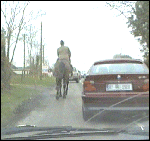
The incident came shortly after two ICABS observers in a car were forced to make an emergency stop to avoid colliding with an oncoming stag being chased by the hunt club. The terrified animal was running along the centre of a country road at a bend when the near-miss occurred.
The stag looked exhausted and extremely distressed and was being closely pursued by a number of vehicles, a single hound and further back along the road the main pack of mounted riders and dogs.
The observer who tried to film the stag's desperate dash was threatened by one of the hunters chasing the animal in cars. This individual leaned out of the side window and yelled: "Be careful with that camera or I'll smash it over you f*****g forehead."
This incident has been brought to the attention of the Gardaí. So too has the serious danger the hunt was witnessed posing to motorists on both country roads and on a main road to Dublin.
If you have witnessed the Ward Union chasing stags and want to tell your story, please contact us immediately. Photos or video of hunt activities would be particularly welcome. Callers who are concerned about being identified will be guaranteed confidentiality. Please call us now.
|
Tighter gun laws could reduce suicides
The president of the Irish Association of Suicidology, Dan Neville T.D., has called for greater restrictions on the licensing of firearms as part of a comprehensive suicide prevention programme for Ireland.
The call follows the publication of a study carried out in England and Wales, which shows that 45% of suicides among farmers in those regions are carried out by methods easily or specifically accessible to farmers.
The Oxford University study focused on the deaths of 719 farmers from suicide or suspected suicide between 1981 to 1993 and found that firearms featured in 40% of fatalities.
Poisoning by agricultural chemicals and animal medicines also featured widely, as did hanging and carbon monoxide poisoning.
The Oxford research team also found that the number of farm suicides and the number of suicides involving firearms dropped after 1989 when new laws on gun ownership, registration and storage were introduced.
John Tierney
The grisly reality of foxhunting in Ireland
This is what foxhunters do to our wildlife
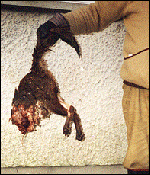
It's a stomach turning image but don't turn away. What you see before you is the horrific fate that awaits foxes pursued and torn apart in foxhunting. This sickening photograph sums up the cruel and barbaric nature of foxhunting in Ireland and the sadism of those involved in blood "sports".
Limerick farmer, and anti-blood sports activist, Dick Power, supplied us with the image and described what led to the violent death of this wild creature.
On 18th January 1999, while observing the activities of the Co Limerick Foxhunt from his farm, Mr Power saw the hunt coming onto nearby land in pursuit of a fox. A friend of his saw the foxhounds tugging at something and went to investigate. What he found was the disembowelled and dismembered creature in the photograph.
|
The sheer terror and pain suffered by this fox is unimaginable. But it is just one of thousands killed in the same brutal way by foxhunting groups in Ireland each hunting season. Look again at the photo above and decide now to do whatever you possibly can to help us ban this barbaric blood sport.
Write to your local politicians, urging them to press for a ban on foxhunting. Write to the Minister for Agriculture, Joe Walsh at the Department of Agriculture, Kildare Street, Dublin 2. Tell him that the so-called code of conduct to which he recently gave his approval does nothing to eliminate the animal cruelty from foxhunting. Demand that he work towards banning foxhunting.
Also consider forming an ICABS support group in your area. Get together with family members and friends who also want blood sports banned and help ICABS campaign against blood sports on a local level.
Drag Coursing
The Humane Alternative
What is drag coursing?
Drag coursing is a humane alternative to live hare coursing in which the greyhounds chase not a live animal but a mechanical device known as a drag. The drag, comprising a piece of cloth or plastic, is rapidly dragged along by a wire cable and can be made to be as unpredictable as a hare and to provide challenging runs for the greyhounds. A "drag course" is a competition between two greyhounds over a distance of approx. 320 metres. Greyhounds are released from slips at one end and they run into a catching pen at the other end.
In hare coursing, points are given to the dog that turns the hare. How are points awarded in drag coursing?
Courses are judged on the principle of the first dog past the line. Though the points system in live hare coursing is different, the reality is that most courses are won by the fastest dog. The first greyhound to reach the hare or the dog that is in the lead when the hare runs into the escape is more than likely to be the winner.
What are the merits of drag coursing?
The most important and most obvious merit is that in drag coursing there is none of the animal cruelty that is integral to live lure coursing.
Since no live lure is needed, the netting of hares (a process that results in great stress and injury to these timid creatures) would be eliminated. There would be no need to confine hares for up to six weeks prior to the start of the coursing meet nor to train them to run towards the escape area of the coursing field. And there would be no controversial hare maulings or kills. Thousands of hares would be free from the threat of coursing and its associated cruelty.
|
Any other merits?
Drag coursing can be held in venues that have modern spectator facilities, e.g. greyhound racing tracks and stadiums. This would attract a whole new audience to coursing events. Also, coursing events could be held during the summer and indeed all year round. As it stands, the hare coursing season is restricted to periods that fall outside the hare's breeding season. This invariably means cold, wet and windy winter weather.
Hare coursing supposedly generates millions of pounds into the Irish economy - could drag coursing match this?
Drag coursing could not only match this but greatly exceed it. The difference in levels of support for these same basic activities - one which involves animal cruelty and the other which doesn't - can be vast. Being a blood sport, live hare coursing is doomed to a bleak financial future. No self-respecting company or business would jeopardise their customer relations by sponsoring a controversial activity that is opposed by eight in ten members of the public. Drag coursing on the other hand is a fun day out for both humans and dogs. As one piece of literature on the subject puts it, "drag coursing is a family event and is conducted in a picnic atmosphere - you can take your barbecue and have a great day out." Without the element of cruelty there would surely be more public participation, more dogs entered and a lot more sponsorship.
Is drag coursing restricted to just greyhounds or can other breeds take part?
Drag coursing is extremely flexible when it comes to the breed of entries. There are special events, of course, for greyhounds only but in addition, drag coursing events can see domestic pets chasing the drag and competing for prizes. Footage obtained by ICABS shows a wide variety of breeds enjoying a day's drag coursing. An individual course can even involve two separate breeds competing against each other.
How beneficial would a transition to drag coursing be to the hare species as a whole?
As well as eliminating cruelty to hares on the coursing field, a transition to drag coursing would also take the pressure off a species which is dangerously in decline now due to modern farming practices and erosion of their natural habitats. Numerous ICABS supporters living in the country have expressed their concern that hare populations are low and that seeing hares is not as common as it may have been in the past. A ban on hare coursing would help to allow the species as a whole to recover somewhat.
How can I help to bring coursing to an end and have it replaced with drag coursing?
The power of change is in the hands of our politicians. In 1993 they failed to support legislation to ban coursing but the campaign most certainly goes on. Write to your local TD and express your opposition to hare coursing. Educate him/her about the humane alternative and present the facts about drag coursing. Another way to help is to become an ICABS observer and help us to continue exposing the cruelty of coursing. Observers attend coursing meetings and report back on the cruelty they witnessed - this information can prove vital to the campaign.
Priestly Behaviour
Coursing Cleric unrepentant over involvement in cruelty
A Kerry priest whose greyhound won in the national coursing finals in Clonmel has once again highlighted the hypocrisy of certain members of the Catholic clergy in Ireland.
South West Cork-based Fr Maurice Brick caused outrage over his participation in the blood sport event and has led to renewed calls for the Church to discipline priests who partake in acts involving animal cruelty.
Responding to criticism of his involvement in coursing, Fr Brick refused to acknowledge the integral cruelty. Speaking on the Pat Kenny Radio Show, he outlined how a former parish priest acquired the dog for him in 1994 and that he has since been involved in what he described as the "whole phenomena" of coursing.
He went on to claim that those in his parish who are opposed to live hare coursing would "respect my involvement in it [because] of the fact that it is well intentioned".
One caller into the show, however, reflected what might perhaps be a more likely response from a right-minded parishioner. Caller John's remark was: I am amazed that a priest condones blood sports - If I was in that parish, I would refuse to attend Mass officiated by Fr Brick.
|
Waterford huntsman to leave for Wales
Waterford Foxhounds huntsman, Nigel Cox, is set to leave Ireland for Wales at the end of the current foxhunting season.
Cox, whose secret past was exposed in the Autumn/Winter 1997 issue of Animal Watch, is reported to be joining the Curre Foxhounds which is based on the Welsh border.
In our exposé of Cox's British background, we revealed how during his time with the Albrighton Hunt, Cox received a three-month suspended sentence after admitting to firing a shot into a minibus being used by a group of anti-hunt protestors. The shot caused extensive damage to the vehicle's radiator and had terrified onlookers diving for cover. Mr.Cox also received a one-year conditional discharge for damaging a camera belonging to one of the protestors.
Cox's involvement with blood sports in Ireland began with the Co.Limerick Foxhounds before he moved on to take charge of the Waterford Foxhounds in 1993.
It is suspected that the constant attention being focused on Nigel Cox's hunting activities in Waterford may be one of the reasons for his decision to leave. The presence of monitors at the hunt's twice weekly meets has made the hunters uneasy. In what is believed to have been an attempt to throw monitors off the trail, the hunt ceased advertising the hunt locations in Waterford's local media and even publicised false information about the meets in a British equestrian magazine.
|
We never approved pig racing: Department
The organisers of a pig race were forced to change their tune after they issued a press statement claiming that the Department of Agriculture had given pig racing the thumbs up.
According to the statement, "the Department of Agriculture have approved this stress free and fun-loving sport and are completely satisfied that the racing piglets are in tip top condition".
However, the Department of Agriculture told ICABS that they had not been consulted about the racing. A spokesperson stated: "Contrary to the press release, the Department has not been formally involved in any approval process nor does it have any such function. We now understand that an amended press release has been issued removing the reference to Departmental approval."
"The Department condemns all acts of cruelty," the spokesperson claimed, adding "if any person has reason to believe that the [pig] races involve cruelty to animals, they should draw the matter to the attention of the Gardaí."
The press release had been issued to coincide with a two-day pig racing event in Ballyjamesduff, Co Cavan. Described as a "hilarious" activity, the event was held as part of a "pork festival" in the town.
Tally-ho Temperance
Blood sport OK as long as one is sober?
A Catholic temperance group has demonstrated its total indifference to blood sport cruelty by placing a photo of a hunter on the front cover of its magazine.
The cover of the November issue of "Pioneer" shows Stonehall Harriers hunter, Michael O'Shaughnessy. A story within celebrates his "golden jubilee on the double" - 50 years as a pioneer and 50 years as joint-master of the Limerick-based hunt.
The article, which describes hunting as "a thrill for all", refers to the fact that over the years a priest and a minister were members of the hunt. It all serves to illustrate once again how the Catholic Church, with a few notable exceptions, never fails to disappoint those campaigning against animal cruelty.
It is absolutely astonishing and bizarre that the Pioneer Total Abstinence Association of the Sacred Heart would see fit to celebrate a blood sport in this manner. Can it be that they consider it acceptable to hound, harass, torture and viciously kill wild animals for "sport" - as long as one is sober?
Observer's Report
Glin Coursing Meet, Co. Limerick
Coursing in any locality is an obscenity but particularly so in a picturesque place like Glin, Co Limerick. Overlooking the River Shannon with its stunning mountainous backdrop, coursing in this quaint village is a definite blemish on its beauty.
The presence of blood sport activity is initially signaled on the village's main street where a shop houses a shrine to coursing in its window. The bizarre display includes photos from past coursing events, coursing clippings from newspapers and cups won by dog breeders. It is a unmistakable sign that behind the facade of Glin, an ugly underbelly hides.
Not far from the window display, down a narrow country road, the day's coursing has begun. Rather worryingly, a considerable proportion of the crowd inside is made up of youngsters. Most, admittedly, are attracted to the stalls selling plastic toys and sweets but others, standing alongside their parents, are trying to be interested in the coursing.
One child hums the lone ranger theme tune as he watches the hare trying to gallop to safety. Another innocently asks his father "what dog should I shout for". The presence of a nappy dumped near the entrance suggests an even younger attendee. The parents don't seem at all concerned about exposing their offspring to violent animal cruelty. As I bring to mind the efforts in Spain to bar under-14s from bullrings, one father lifts his child up to get a better look. A hare, which the boy mistakes for a "bunny rabbit", has just got knocked head first into the grass.
|
During my time observing I saw two hares mauled into the ground like this. One was sent head over heals and head over heals again. As shocking was what happened to one of the greyhounds.
Two dogs sped out of the slips and were in close pursuit of the hare. When they neared the fleeing creature, it hastily changed direction to try and shake off the dogs. One of the dogs similarly altered course but as he ran on, his opponent suddenly uttered a yelp and sank to the ground.
Several spectators knew exactly what had happened and they confirmed my suspicions by telling each other that the dog had just broken a leg. It was a painful thing to watch. Someone came onto the field soon after and lifted the helpless hound away. My observing partner wondered if the dog would survive to the end of the day. A broken leg might not normally be a life-threatening injury but for a coursing dog it most certainly can - after all, dogs with broken legs can't win money in coursing.
As we departed this ill-atmosphered place, I wondered about that greyhound. As Glin and its site of animal abuse fell away behind us, I wondered if someone would go to the expense of calling a vet, getting the damaged leg looked after, nursing the dog back to health - or simply stick a shotgun to its head.
ICABS Observer
Observer's Report
Westmeath United Coursing Club
Type of meeting: Enclosed Coursing
Date: 22nd November, 1998
Times observers present: 11.30am-end (2.30pm approx.)
Weather: Damp and cold
Condition of field: Saturated
Condition of hares: Mostly young, small & thin
Attendance: 100 approximately. Mostly male. Some children. One young teenager was a mounted judge.
Figures: 2 kills, Several knocks, numerous non-courses
It seems appropriate that such a filthy pastime as coursing is held in the filthiest of conditions. The lane leading up to the Westmeath United coursing field was splattered with mud, the entrance was a mire of muck and once inside, a criss-cross of dirty tire tracks dissected the saturated field of the viewing and parking area.
When the coursing started on this second day of the club's meeting - November 22nd - it became clear that the condition of the main coursing field was as dreadful as the slippery trek up to see it. Successive courses saw sprays of water shooting up behind both greyhounds and hares.
Not long after the start, the first mauling was witnessed - one of the hounds thundered into a hare and sent the creature toppling over. Losing its foothold, it became even more vulnerable. The hounds were on it in an instant, digging their muzzles into the hare's belly. As coursing officials rushed in to intervene, the hare looked as if it might have seen a way out but no, the dogs lurched forward and began pounding the hare once again.
The battered thing an official pulled from the dogs was not moving. When he slowly walked away with it gripped in both his hands, it remained inanimate. Reaching the far side of the field he opened up a wooden box and threw the hare in before standing at the ready for the next course.
A number of other hares were knocked over by the dogs, one being violently cartwheeled over and over before landing awkwardly and rushing away. Others were knocked sideways off their feet.
A noteworthy feature of this day's meeting was the large number of non-slips. This is when hares are let up the field without any greyhounds being released and is done when particular hares are considered unfit for coursing, i.e. they would not give the dogs a good run. One such hare provided a particularly distressing display.
Moving slowly up the field, it was obvious that this thin and young-looking hare was not at all well. The ploys of the four officials on each side of the field to hurry the hare along (typically they shout at it or beat sticks against the fence posts) had no effect. Instead of continuing on towards the escape area, this unfortunate hare came to a stop. Then it moved forward a bit and then came to a halt again. What happened next was as depressing as seeing a hare being pummeled into the ground by hounds. The hare suddenly collapsed onto the grass. One moment it was upright and the next its whole body was flat.
It was even more sickening when the coursing official standing closest to me jokingly quipped to onlookers: "That one musta got a heart attack". He may not have recognised the truth in his words but into my mind came what was once said by a member of the University of Cambridge's Animal Welfare and Human-Animal Interactions Group. According to Professor Donald Broom: "When a hare is chased by a predator like a dog it will show physiological changes associated with extreme fear. These include greatly elevated heart rate".
How many times had that hare been chased by greyhounds before making its appearance on the field, I wonder. And how many hares similarly collapse once they disappear into the so-called escape? Coursers claim that hares which make it into the escape are safe, but what they say is never very convincing.
Before the first break of the day, another mauling occurred. It began just like the previous one but when all three animals went from view into a dip on the other side of the field, what followed was not visible. What was visible was another lifeless hare being carried away. Into the wooden box it was dumped alongside the two that went before.
It is mostly hares that are the victims in coursing but we must not forget about the greyhounds. They too, frequently sustain injuries on the coursing field. During a "bye" (a course involving just one greyhound, the other dog being withdrawn or disqualified), the greyhound came sprinting up the field with its quarry in sight. It was so focused on catching the hare that when the latter ducked under the green boundary of the escape, the greyhound smashed right into the barrier. It was painful to watch. The mounted judge knew the result - I overheard her saying: "that dog's injured". Her prediction proved to be true because soon afterwards, the hound was seen limping away as its handler rushed in to retrieve it.
The final course of the day saw the final display of animal cruelty. Towards the top corner of the field, the pair of greyhounds had closed in on the hare. As the crowd roared the hounds on, I saw the hare being thrown straight up into the air. Its feet hung below it as its whole body was sent flying upwards. When it landed it was chased into a wire mesh perimeter fence. Somehow it kept moving and managed to reach the nearby escape. Not without severe injuries from those two blows, I am sure.
From watching the day's coursing, I was struck by the condition of the hares being used. I noted that many of them appeared very young, small and thin. To me, there was little difference in size and age between the "non-slip" hares and the hares that were actually coursed. The cruel abuse to which I saw the hares being subjected made it more than clear why over eighty per cent of the Irish population find this blood sport unacceptable and wish to see it being made illegal.
ICABS Observer, Westmeath
Observer's Report
Mallow Coursing Meeting, Co Cork
Date: November 7th and 8th, 1998
Type of meeting: Enclosed Coursing
Date Present: 7-11-98
Times observers present: 12 noon to 2.30pm
Weather: Gail force wind and cold
Condition of field: Soft underfoot
Attendance: 200 approximately
Figures: 56 courses, 4 kills, 11 non-courses
I arrived at the venue where 3 coursing officials were at the gate collecting the admission charge of £5. When I entered the coursing area, the "Rakes of Mallow and Walsh Cup" was underway.
Positioning myself near the entrance where the hare hopefully will escape, I had a good view of the proceedings. After 15 courses and 4 non-courses I saw the first mauling of the day. The two greyhounds had pinned the hare to the ground. One coursing official and two children ran to intercede, with the coursing official dragging the hare which was now screaming in pain.
After another incident when a hare was mauled and killed, I witnessed a coursing official trying to separate the greyhounds and hare when a dog owner came rushing to the scene and physically attacked the coursing official. A bout of fisticuffs ensued when I heard the coursing official shouting at the dog owner that you never put the "f*****g muzzle on properly".
ICABS Observer, Cork
Bronx bullfight claim a load of bull
Following an incredible suggestion in a UK animal rights newsletter that a bull ring was to be constructed in the Bronx, New York, ICABS investigated and found that, thankfully, the claim was a load of bull.
According to a spokesperson for the American Society for the Prevention of Cruelty to Animals, the story probably arose after an article appeared in a New York newspaper.
"A columnist for the paper wrote that a bullfighting ring was to be constructed in the Bronx," she outlined. "However, he was not serious."
"It would be illegal to hold bullfighting in New York state," she added.
Meanwhile, Marc Cornstein of the New York City Sports Commission told ICABS: "There have been no plans made to construct a bullfighting arena anywhere within the five boroughs of New York City. Even though New York enjoys the greatest cultural diversity of any city in the world, and we are constantly seeking ways to enhance our international flavour, bullfighting is not a subject that has been approached."
Landowners' role in finishing foxhunting
ICABS congratulates farmers for decrease in hunting grounds
In their "Leave Country Sports Alone" leaflet, the Irish Masters of Foxhounds Association concede that "without the co-operation of the farming community, hunting would cease to exist altogether."
We agree entirely and that is why the part of our campaign that deals with helping farmers to keep hunters off their land is ongoing. Throughout the hunting season, ICABS distributes numerous copies of our "Troubled by the Hunt" leaflet. We advise farmers on the best course of action to take to protect their land and livestock from hunters.
We have the greatest of empathy for farmers who are being plagued by hunters and who have to waste time being on constant alert for incidents of trespass. The presence of foxhunters can prove extremely distressing for farmers, particularly when damage is done to precious pastures, fencing or when livestock is disturbed or even killed.
The "Troubled by the Hunt" information leaflet is a step by step guide to the best route to take when hunters start posing a threat to your livelihood. Firstly recommended is the publication of a preservation notice in the local newspaper and the sending of a formal warning to the hunt master that any invasion by hunters and/or hounds will be viewed as a trespass. We also stress the importance of gathering evidence of trespasses either on film or video tape. This can prove very important if and when the matter is brought before the courts.
Farmers want to keep their property off-limits to hunters for a number of reasons. These include the damage caused by packs of horses and hounds - a field of grass can be turned into a hoof-marked mess in a matter of minutes; a field being used to keep livestock in can instantly become unsuitable when a hunt, ploughing through hedges and over fences, leaves openings for livestock to wander out. Livestock can also be worried by hunt hounds and the sudden presence of hunters on horseback, resulting in, for example, pregnant animals having miscarriages. Another threat posed to farmers by the hunt is the fact that foxhounds are known to be carriers of infectious parasites which can prove fatal if passed onto farm animals.
It has been extremely encouraging to note that at the start of the last hunting season, there has been an apparent increase in the number of preservation notices appearing in local papers around Ireland.
The message to hunters in these notices is clear - stay off our land or face prosecution. Here is a list of some of the messages found in local papers from around the country: "Lands preserved for the protection of wildlife, livestock and fences; no foxhunting", "foxhunting on horseback and on foot strictly prohibited due to disease eradication", "No shooting or hunting for the protection of sheep and wildlife", "No foxhunting. Trespassers will be prosecuted", "Hunting on horseback or on foot forbidden", "Lands preserved from all forms of hunting and shooting", "Our land is designated as a wildlife sanctuary - hunting strictly prohibited", "Lands are strictly preserved for protection of livestock - no hunting or shooting allowed; trespassers prosecuted", "No foxhunting allowed", "No trespass by hounds or horses", "No trespassing; no exceptions", "No hunting all year round", "No hunting or shooting of any description allowed", "Lands preserved for the protection of livestock; no shooting or greyhounds allowed", "Lands preserved for the protection of sheep", "Land preserved for the protection of livestock and fencing, no foxhunting, harriers or shooting", "Land preserved for the protection of livestock and fences; no harriers or foxhounds."
A massive notice that appeared in the Limerick Leader was a particularly welcome sight. The notice, stating that "hunting on horseback and beagle hunting is strictly forbidden on our lands" was signed by over 60 landowners.
ICABS invites all farmers who are experiencing problems with the hunt to contact us in confidence for a free copy of the "Troubled by the Hunt" leaflet as well as any advice we can give. We thank all the farmers and landowners who have been in touch with us in the recent past and who have taken steps to help reduce hunting grounds and speed up the demise of foxhunting with hounds.
Real Holiday Show promotes Ireland as haven for blood sports
The Irish Council Against Blood Sports has expressed its shock and anger over a popular Channel 4 holiday programme which featured foxhunting in Ireland as a fun option for British holidaymakers.
A pair of guests on the "Real Holiday Show" - described as being "so passionate about their hobby that they even continue to pursue it on holiday" - gave the programme the opportunity to present the usual picture postcard image of foxhunting that foxhunters are so eager to portray. We were shown riders on horseback galloping across countryside and a pack of hounds running ahead.
No mention was made of the cruelty. We weren't shown a terrified fox running for its life, or a fox being dug from the earth by terriermen with shovels or a fox being torn to shreds after being caught by the hounds. For a programme that claims to show the "real" side of holidaying, the foxhunting feature made a mockery of its aims.
In a complaint to programme producers, Chapter One, an ICABS spokesperson stated that "it beggars belief that a holiday programme would see fit to promote a cruel blood sport which the majority of its audience, both in Britain and Ireland, are opposed to".
ICABS also emphasised to the producers that the majority of Irish people are opposed to blood sports, and while we warmly welcome visitors to our country to sample the beautiful scenery and hospitality, the majority would not welcome any visitor who partakes in abuse of our wildlife.
Please write to the Real Holiday Show, expressing your disappointment that a real picture was not given of the cruel blood sport of foxhunting. Tell them that you are disappointed that they have encouraged holidaymakers coming to Ireland to take part in animal cruelty.
|
Bord Fáilte denies promoting hunt holidays
Despite being connected with a controversial equestrian guide that directs tourists to foxhunts, Bord Fáilte has denied that it has resumed promoting hunting holidays.
The South East Tourism-produced "Guide to Equestrian Activity in Ireland's South East" booklet includes a section on hunting and a listing of overseas Bord Fáilte offices where further information can be obtained. A contacts page at the back of the booklet also has a listing for the Irish Masters of Foxhounds Association.
Maintaining that the main objective of the booklet is "to promote equestrian holidays and not hunting holidays", Bord Fáilte Marketing Executive, Ciara Gallagher, told ICABS: "Bord Fáilte does not promote hunting holidays in Ireland at travel fairs, in advertising campaigns or in newspaper/magazine articles, etc. However, we do service all enquiries received and as hunting is legal, Bord Fáilte continues to provide information on this activity to enquirers".
According to a report in the Waterford News & Star, ten thousand copies of the booklet are to be distributed in America, Europe and Britain by both South Eastern Tourism and Bord Fáilte.
Anti-bullfighting News from Spain
Doping of bulls confirmed
An individual close to the bullfighting world has finally confirmed that the use of behaviour-altering drugs on bulls is commonplace in Spain.
According to a detailed report in "Esto" magazine, the bullfighting insider outlined that "a large number of bulls are doped...either to induce drowsiness or to stimulate them."
The report stated that sedatives are injected into bulls when they are being taken from the bull breeding ranches to bullfighting arenas. This is done to make the animals lethargic and prevent them from reacting to natural fear and stress and becoming aggressive while in transit. Such aggression in a confined space could lead to damaged hooves and horns, thus making the animal unsuitable for an appearance in the arena.
If the bull is still suffering the effects of the drugs prior to the "fight", it will be injected with a strong vitamin complex which according to its label is an "invigorating, general stimulant which improves growth".
Some unscrupulous bull breeders also use the same drug to make their bulls more aggressive in the ring and to enable injured bulls to continue fighting.
Survey shows interest in bullfighting is dwindling
A recent survey carried out in Spain has revealed that just 14 per cent of people have a "strong interest" in bullfighting. Those who have some interest amounts to 17 per cent while those with no interest at all is an overwhelming 68 per cent.
The results of the survey conducted by Equipo de Tabular also showed that the televisation of bullfights draws low audience levels. Of those questioned, 35 per cent said they never watched bullfighting on TV, 30 per cent said bullfighting should never be screened and 19 per cent said they did not care either way. A meagre 13 per cent admitted to enjoying bullfighting on television.
State-owned channel Televisiôn Española (TVE) has been severely criticised for subsidising blood sports and wasting taxpayers' money on programmes which are drawing such low ratings. The company reportedly loses thousands of millions of pesetas each year - during 1997, the channel paid the equivalent of $6.06 million for the broadcast rights to 34 corridas. This sum would provide over 78 hours of popular primetime programming.
Anti-bullfighting group, ADDA, has vowed to continue its campaign against the four TV channels that still screen bullfights. They say that more than a quarter of a million postcards of protest have been sent so far to TVE, Antena 3, Tele 5 and Canal Plus.
|
Industry's audience figures "impossible"
Claims by the Spanish bullfighting industry that 65 million people visit bullrings every year has been described as "impossible".
When the situation was investigated by Seville's ASANDA it was revealed that even if every bullring in the country was overflowing with spectators, it would not be possible for more than 26 million people to visit bullrings every year.
Considering that the majority of bullfights are at best half empty, it is unlikely that the collective audience could be anything greater than 13 million.
Bullfight school closes
A bullfighting school in Catalonia was forced to close down after a fund-raising event ended up making a loss of 3.5 million pesetas ($23,300).
The collapse of the school has been welcomed by anti-blood sports group, ABC International, who commented: "From now on, students can concentrate their studies on vocations that are more in tune with a modern, civilised country."
Olot of disappointment
ICABS was very disappointed to learn that, despite earlier reports to the contrary, bullfighting continues to take place in the Spanish town of Olot. In our Autumn/Winter 1997 edition of Animal Watch we reported how bullfighting had actually been banned from the town. Similar reports were also carried in the Spanish press.
However, the latest is that the town's one remaining bullring - one of the oldest in the country - is still in operation. Two bullfights are held there annually to mark the fiestas of the town's patron saints and these are heavily funded by the bullfighting industry who obviously fear the venue's closure.
One piece of good news from Olot is that sponsorship for one of the events has been withdrawn by the Town Council. Following efforts by anti-bullfighting mayor, Macia Pedrossa, the council ruled that there would be no more financial support. They have also demanded that the name of their town be removed from bullfighting's "City of Olot" trophy.
(Thanks to Anti Bullfighting Campaign International/The Bull Tribune for the above stories and information. For more details on ABC's anti-bullfighting campaign, write to: ABC, Calle Pere Verges, 1, 10º, Despatx 10.3, Edificia Piramidón, 08020 Barcelona, Spain.)
Friend of the Foxes
It all began in the summer of 1995 when wildlife enthusiast Peter Akokan was awoken from a nap by a loud bang on his front door. Outside on the door step was a woman with a cardboard box. And inside the box was the young cub which would draw him into a life of rescuing foxes.
Although that first rescued fox didn't survive, Peter has gone on to achieve a very impressive record of saving foxes. "Ninety per cent of orphan cubs and injured foxes that have come to me," he says proudly, "have successfully been released back to the wild."
Interested in all aspects of wildlife from a very early age, Peter first started seriously studying foxes ten years ago. In that time, he has closely observed foxes in rural, low-populated areas as well as in heavily populated urban habitats.
His interest in, and love of, foxes has led him to the formation a new group called Foxwatch Ireland, the aim of which is to give the fox a better image and to get people interested in watching foxes in the wild.
"The idea to start a foxwatch group in Ireland," says Peter, "came after meeting Martin Hemmington of the UK's National Fox Welfare Society who has started a foxwatching network throughout Britain. When I went out foxwatching with him, I thought 'what a good idea it would be if I just brought that idea back to Ireland' and that's what I did."
|
Asked about what originally sparked his interest in foxwatching, Peter points to two moments of particular significance.
"About ten years ago, I remember when I first saw a fox out hunting. Walking up a hill, I disturbed a hare and noticed that there was a fox waiting at the bottom of a nearby fence, crouched and ready to ambush it. The fox jumped out and just missed the hare by about an inch. At that time it was a great observation even though I didn't see the fox catching the hare but seeing it happening so close was great. I have been hooked ever since."
"What really got me started in foxwatching," he continues, "was when I was in a book shop one day when I was living in Northamptonshire. I was looking through the natural history section as I usually do when I walk into a book shop. I came across a really excellent book by Roger Burrows called 'Wild Fox' - it's the bible of foxwatchers! I bought the book immediately and since then I have been constantly going out and following what's in it. I've learnt an awful lot and wouldn't have been anywhere near where I am now with fox observation if it hadn't been for that book. I'd advise anyone to read books like that if they really want to get close to wild foxes."
The foxes brought to Peter's Roscommon base range from those found lying at the side of a road to those dug out by heartless hunters. Foxes are brought to him by individuals as well as animal welfare groups like the Galway SPCA. Recently, Peter responded to a call by the Irish Council Against Blood Sports to rescue an exhausted fox believed to have narrowly escaped from a pack of foxhounds.
Outlining his procedure for dealing with rescued foxes, Peter stresses that human contact with the foxes must be kept to a minimum. "Basically, don't get too friendly with them," he says. "If you're going to rescue foxes, you have to do it seriously and it's not good to allow an animal to become tame and then keep it in a cage for the rest of its life. The aim of the whole process is to get them back into the wild. Getting too friendly with them is not what you want."
One fox presented to him - a cub ripped from its earth by a terrierman - is proving particularly difficult to rehabilitate back to the wild.
Explains Peter: "Penny came to us when she was four weeks old and she had been brought up from when she was just two days old. She was brought up with children handling her every day in a house - like a puppy. When she arrived to me she was very tame and immediately she took to our dog Silky and saw her as a mother. Penny is now friends with both our dog and cat and the three eat out of the same bowl. It's lovely to see them coming up and eating together.
"She's very dependent on human beings though and for me, it's very difficult to part with her since she's been around for so long. She's been like a house pet which isn't really what we wanted. But slowly she's getting further and further back into the wild. I'll let her go whenever she likes. In other words, even though she's so tame, I'm not saying she belongs to us; she belongs to the wild so hopefully that's where she will return."
Philip Kiernan
|
ISPCA branch may face dis-affiliation over blood sports stance
Prominent members resign
The Kildare branch of the Irish Society for the Prevention of Cruelty to Animals may face disaffiliation after publicly stating that it does not oppose blood sports.
ICABS has learned that a letter appealing for donations which was sent by the KSPCA to local members stressed that the group was "not against field sports". When a copy of the letter reached the head office of the ISPCA in Dublin, we understand that steps were taken to discipline and possibly disaffiliate the branch on the grounds that it was contravening the ISPCA constitution. This constitution outlines that member societies around the country must adhere to ISPCA rules including those relating to the use of animals in sport and entertainment.
These rules state that the ISPCA "opposes any activity that involves pitting animals or humans against animals in hunts or fights...the society opposes foxhunting, live hare coursing, stag hunting and otter hunting [and] particularly opposes "sports" which involve the blocking of earths or the digging out of animals that have gone to ground."
A copy of the letter obtained by ICABS leaves no doubt as to where the Kildare SPCA stands on the issue of blood sports. According to the letter: "Our constitution states that we are not anti-field sports, so I ask you for your support to continue this essential work for the animals, both domestic and wild".
One Kildare anti-blood sports businessman who contacted ICABS expressed his disgust and disbelief at the content of the letter, saying "for a group that claims to work for the prevention of cruelty to animals, it goes beyond belief that they would not be opposed to the cruelty of so-called field sports."
"After reading the letter they sent me," he added, "I think they might be better known as the Kildare Society for the Promotion of Cruelty to Animals".
Plans to launch the controversial fund-raiser led to the resignation of two prominent and hardworking members of the Kildare SPCA. We understand that Paul Dempsey, the KSPCA's inspector for six years and Geraldine O'Hanlon who runs the Kildare Animal Foundation Rescue Centre, have both resigned on principle.
Mr Dempsey told ICABS that this wasn't the first time he encountered pro-blood sport sentiments within the KSPCA. "When I started working for the KSPCA six years ago," he said, "I had anti-foxhunting and anti-coursing stickers on my vehicle. I was told to remove them. I couldn't understand it."
The Irish Council Against Blood Sports welcomes the stand taken by the ISPCA and will be urging them to disaffiliate all member societies who support blood sports or are ambivalent on the issue.
ICABS is also warning members of the general public who donate to local SPCAs to be aware that some societies do support blood sports, and to exercise cautious when making donations.
We'll destroy our dogs before rehoming them
A dog lover who phoned a hunt kennel in Galway to ask about buying a retired foxhound was told we'll destroy our hounds before selling them.
The caller was told by kennel staff that dogs no longer fit for hunting are strictly not for sale...because they're put down instead.
The Midlands caller told ICABS he was shocked by the kennel staff's attitude towards their dogs. "They told me that hounds that aren't good enough to hunt or that aren't mating anymore are put down and not sold," he said.
Not even guaranteeing a good home for a retired hound would save the dogs from their destiny with death. "They tried to completely put me off getting a foxhound," the caller later said. "They tried to tell me that foxhounds don't make good pets and that they are 'a bit snappy - you have to go in to them with a stick'".
|
Harrier hound killed on road
A hound being used by the Premier Harriers hunt club was knocked down and killed on a road during a recent meet in Co Tipperary.
The incident which occurred in Ballinure came after six hounds veered across a road.
According to a report in The Irish Field, the dog - one of 25 being used on the day - was killed following the pursuit of a fox into a hillside forest. "The majority ran a fox out across the morning's draw and back again, but three couple[six dogs] went out on the Dualla side and crossed the road, before swinging back and re-crossing the road here. Unluckily, a hound got knocked down and killed on the road."
ICABS has brought this incident to the attention of the Gardaí in Ballinure and asked them to address the threat posed to motorists by hunts.
Badger tip
If you come across a dead badger on the road, remove it for burial elsewhere or conceal its body on the opposite side of the roadside verge. Dead badgers on the road can give an indication to badger baiters that there are badger setts in the vicinity. These setts may then be added to their sites of destruction.
Be aware, however, that if you are removing a badger killed on the road, the Wildlife Act states that "a person who is not a licensed wildlife dealer shall not have in his possession a protected wild animal, whether alive or dead."
Government's TB Eradication policy misguided
Badgerwatch's Bernie Barrett reports on the flaws in a Government scheme based on the cruel killing of 22,000 badgers
Despite its protection under the 1976 Wildlife Act and being backed by Europe's longest-standing wildlife treaty, the Bern Convention, our badgers are still persecuted by the illegal activities of badger digging, baiting and lamping. It's not unusual to see the individuals who indulge in such pastimes boldly walking the streets fully equipped with spades, probes, sacks and the usual clutter of "working terriers" straining on their leashes.
They will, of course, if challenged, maintain that they are after foxes - equally unacceptable but sadly legal in this country. Since it is only possible to monitor a few, it is true to say that in some parts of the country, these illegal activities are out of control.
The Wildlife Service would do the job but they too are hampered by lack of manpower and resources. In short, our wildlife - particularly the badger - may owe its survival to the vigilance of the local people. Indeed this has been proven recently when a successful prosecution was brought against three individuals.
|
As well as all of this illegal torture, the Government through its misguided policy, legally snares and shoots badgers for "research" into the problem of bovine TB. This must be the longest running "soap" in living memory. Millions are spent annually on funding the Bovine TB Eradication Programme. Badgerwatch has been (unsuccessfully) requesting the Department of Agriculture to produce the full report of the East Offaly Badger Removal Project for some time now.
This scheme alone cost the lives of 1,700 badgers. Because it was scientifically flawed, however, it was necessary to replicate the project in 1997 in order to validate its findings. The present project is "researching" in areas of Monaghan, Cork, Kilkenny and Donegal. Their figure for badger casualties currently stands at 1,300. Snaring by the Department of Agriculture began in the early 1980s and to date has cost the lives of 22,000 badgers. And we are still no nearer to a solution!
The actual snaring of badgers by the Department is in itself cruel and barbaric. The Government claims that cage trapping is too expensive. Snares are set in the evenings and are checked every 24 hours. A captured badger will be left struggling and terrified for hours until the fateful shot from a .22 rifle ends its life the following morning.
Recently on local radio, a high profile (recently retired) farming gentleman confidently assured listeners that the Dept. of Agriculture actually killed snared badgers by administering blows to the head - to dislocate the spinal cord, he explained. Snaring continues through the animal's breeding season, January to June. This has caused serious welfare problems as there is no respite for nursing sows. They too will be shot, leaving their orphaned cubs to die underground from starvation.
Badgerwatch's campaign has centred around convincing the Government that the way to solve the bovine TB problem does not include wholesale slaughter of a protected species. To begin with, we need a TB test that is better than the present one which is only about 80 per cent accurate. We need a restriction on cattle movement. Animals that have been tested in a twelve month period can now be moved around the country. Irish cattle are moved far more frequently than their European counterparts.
Incidentally, Ireland was declared legally bovine TB free in 1965 by the then Minister for Agriculture. That was achieved by strict monitoring and the imposition of a 14 day pre-movement test. It did not include a badger control programme.
Ultimately, we need a cattle vaccine but that seems to be a decade or two down the road. It is our opinion that badgers picked up the TB infection from cattle in the first place and the level of TB present in badgers merely reflects the level of infection already present in cattle. Almost twenty years have passed and they still have not managed to pin the blame on Broc - the evidence against the badger is likely to remain circumstantial.
Where are we going from here? Badgerwatch intends challenging the legitimacy of our Government's policy of culling thousands of badgers for "research" purposes. We will shortly present our complaint to the Standing Committee of the Bern convention, to which Ireland is a signatory. We will request that a file be opened on our complaint that Ireland is in breach of Articles 7, 8 and 9 of the Convention. It was heartening to hear that Nuala Ahern, MEP (Green Party) had already done so and we understand that many of our leading animal welfare groups will do likewise.
Badgers are now facing local extinction in areas of Offaly, Cork, Kilkenny, Monaghan and Donegal. Misinformation to farmers has led to illegal badger killing on a grand scale. It might be true to say it has also encouraged them to turn a blind eye to badger digging activities. To add to its troubles thousands of badgers die on our roads annually. Ireland must now meet its obligations to wildlife protection and review its badger control policy.
Members of the public can help by writing a short letter to their elected representatives in Dáil Éireann. Letters to the local or national press also help to highlight this issue. Badgerwatch is grateful for any support that will focus on the plight of the badger in Ireland.
For more info on Badgerwatch, write to Bernie Barrett, 5 Tyrone Avenue, Lismore Lawn, Waterford.
Animals are the real fashion victims says report
For fox sake, boycott fur
There may have been a huge recession in the fur trade over the past decade and a half but millions of animals still continue to be killed for their fur every year.
Sales of fur in some countries may have dramatically fallen by up to 90 per cent but the fact is that foxes, mink, racoons and other fur-bearing animals continue to suffer to supply this cruellest of trades.
A campaign just launched by the World Society for the Protection of Animals is focusing on the 30 million creatures that suffer a life of misery on so-called fur farms. The group's inquiry into the fur trade has concluded that these "real fashion victims" suffer no less than those killed or maimed in crude leg-hold traps.
The inquiry was carried out to expose fur industry propaganda which claims that farming animals for their pelts involves no cruelty. This is absolutely untrue, according to the report which points out that between 10 and 40 animals have to be slaughtered to make each garment. And the methods of killing are far from humane.
The animals are killed when they are about eight months old once their first full growth of fur is in place. Their life of misery in a cage no larger than a supermarket trolley ends with a horrific death. Methods used to kill them include gassing, electrocution and lethal injection. Others are clubbed to death or have their necks broken. The main consideration in the killing process is that the fur is not damaged.
|
Regarding foxes, reference is made in the report to a Dutch study which found that fur farm foxes exhibit a state of excessive fear. Female foxes display "a serious form of disturbed behaviour" with an estimated 10-20 per cent performing infanticide. Another survey shows that 50 per cent of all cubs born were killed by their mothers. Fear of contact with humans is another form of stress suffered by caged foxes; when being handled, neck tongs often have to be used.
The WSPA is now calling on compassionate consumers and fashion designers to shun fur on the grounds that it can never meet basic animal welfare needs.
In appealing to the public to boycott fur, Catherine Aga Khan says in the foreword to the report: "Fashion is about moving with the times as well as evolving moral, ethical and aesthetic perceptions. On this basis, the fur industry - and all those who persist in sponsoring it - are as cruelly anachronistic as their produce is outmoded."
Pepsi criticised over bullring support
An animal rights group in the US has launched a campaign aimed at cola producers, Pepsi. According to Showing Animals Respect and Kindness (SHARK), an investigation recently conducted into Mexican bullfighting revealed that the Pepsi company is one of the biggest advertisers in the bullrings.
"Their banners and signs are strewn everywhere," a SHARK spokesperson commented. "They are giving their silent approval to this animal torture."
The group is now calling on consumers all over the world to contact Pepsi and urge them to immediately stop supporting Mexican bullfights. The address to write to is: Roger Enrico, CEO PepsiCo Inc., 1 Pepsi Way, Somers, NY 10589, USA.
|
Another shooter makes it on to Heritage Council
Concern has been expressed over the appointment to the Heritage Council of another individual involved in shooting.
The appointment of Barefield Gun Club member, Michael McNamera, brings to two the number of Council members involved in shooting wildlife.
This is a very worrying trend considering that one of the functions of the Heritage Council is to provide advice on matters concerning the protection and conservation of wildlife. ICABS suspects that the presence of shooting enthusiasts on the council may serve to further the aims of shooting organisations in Ireland.
An existing Heritage Council member, Jimmy Dunne, is even a former chairman of shooting organisation NARGC. Dunne, who libelled two senior members of ICABS in a 1987 shooting magazine, was subsequently forced to apologise for his false remarks.
The ability of those who kill animals for sport to make it onto the Heritage Council is not at all surprising. According to the Wildlife Act, Wildlife Advisory Councils "shall include persons [with] a knowledge of, or interest in, field sports" . This is one of several parts of this outdated piece of legislation which ICABS wants to see being changed.
An Irishman's Drivel
An article written in praise of foxhunting by an Irish Times columnist has been slammed by Sunday Independent columnist Hugh Leonard.
ICABS Honorary President, Leonard, criticised the Irishman's Diary article which suggested that hunters were doing foxes a favour by chasing and cruelly killing them.
Remarked diarist Kevin Myers: "If [the hunters] get a fox, it will be a lucky fox, one that this night will not now die of cold or famine or disease but will be instantly dispatched."
This silly argument led Hugh Leonard to pose the question: "If given the choice, would Mr Myers himself choose a natural death or elect to be chased by a pack of hounds and a gang of half-cut Hooray Henrys on horseback and then torn to pieces. Is that his idea of instantly? Some instants can be endless."
|
Australian Minister's cowardly compromise
Cruel pig hunts set to continue
Last year he promised a ban on cruel pig hunts but now New South Wales' Agriculture Minister has reached a cowardly compromise. Hunting wild pigs with hounds will not be lawful - unless, that is, you are a farmer hunting them on your own property.
Animal welfarists in Australia have criticised Minister Richard Amery for not going far enough. The partial ban makes it extremely difficult to determine whether individuals spotted hunting pigs are breaking the law or not.
Hunting of the feral pigs, known as "pig dogging", was actually denounced last year by Minister Amery who compared it to barbaric bear baiting. It involves the use of vicious dogs to chase and capture the pig and hold it until the hunter arrives to stab it in the heart or slit its throat.
Some districts of New South Wales succeeded in making pig dogging illegal under the Rural Lands Protection Act although hunters are still allowed to shoot the pigs. Landowners had expressed concern over the tendency of hunters to release their dogs into the wild without retrieving them. These dogs then posed a risk to humans, wildlife and livestock.
Collision Course
Confusion over lure leaves onlooker legless
A coursing spectator at the annual Balbriggan meet was knocked cleanly off his feet and straight onto the ground by a greyhound intent on letting nothing get in his way. The incident occurred as the pair of dogs were rushing in to attack the fleeing hare - one hound came into contact with the man and sent him hurtling onto the grass.
The two-legged quarry proved but a bonus for the hounds, however, as they also simultaneously caught and battered the hare. A sickening display saw them throwing it into the air and sending it toppling over and over. They continued the chase and eventually trapped the unfortunate hare just yards from the escape.
The sight of a greyhound knocking a fully grown adult over is a frightening reminder of the scale of impact felt by hares when pounded by the dogs. The sheer force which resonates through the fragile bodies of hares leave them at great risk of dying from their injuries.
It continues to be clear that the muzzling of coursing dogs is purely incidental when, all too frequently, they smash into a fragile quarry with a mass ten times less than their own. The Irish Coursing Club's Gerry Desmond has even admitted that muzzling means little to hares being battered. "It was found that the hares were being damaged by the muzzles [and] it led to suffering by the hare afterwards," he has gone on record as saying.
|
Observer's Report
Castletown-Geoghegan Coursing Club - a new field and "a lot less" supporters
All the coursing venues I've had the mispleasure of visiting appear to hold common sets of characteristics.
Each venue invariably has to be susceptible to transforming into a muck pit by the time the coursing gets underway and the venue must be located on the most out-of-the-way site available.
Securing my vehicle on terra firma (outside the confines of the venue naturally), I immediately noticed that something had changed here. Previously, the coursing field was parallel to, and only a short distance in from, the bordering lane. But now it was an additional field away. The field on which the coursing had taken place two years ago had been abandoned for an area less visible from the roadway. One wonders if this was as a result of the protest and the resultant television exposé. Could the coursers be fooling themselves into believing that by retreating further from the public gaze, they could prolong their primitive pastime?
After a lengthy delay, the reason for which went unannounced, the second day of Castletown-Geoghegan's two-day meet got underway. Looking around, the meager gathering of spectators provided a satisfyingly pathetic display. I overheard one remarking that there was certainly a lot less here than last year. Perhaps the freezing weather and damp grass underfoot kept them away. Or perhaps, as evidenced elsewhere, interest in this cruel (and not to mention monotonous) pastime is waning.
The new field, now angled inwards and upwards, leads up to the escape area where coursing clubs claim the hares settle down nicely if they escape from the pursuing dogs. From my position, however, I could see that this claim is complete rubbish. Every time a hare was chased into the escape, I could see the other hares within running frantically around the inside perimeter of the enclosure. They were definitely agitated and in their eyes, I am sure, this was no escape. Each hare that came speeding in, appeared to bring with it a renewed sense of danger for the hares.
The slips today, in my view, were somewhat longer than normal. In other words - for those not familiar with coursing terminology - the head start given to the hare before the two greyhounds are released was a bit more than usual. One fellow standing closeby, who obviously wanted to see more interaction between hares and dogs, was disgusted with this. Pointing up the field, he referred to one of the coursing organisers as a dopey b*****d.
For many of the coursers I was keeping an eye on, the hare seemed more or less incidental. In a lot of cases, they prematurely turned away from the hare's desperate dash. Before the hounds caught up with it, these spectators knew the result. The winner was the greyhound that was in the lead as the pair of dogs began closing in on the quarry. Looking at these coursers, and watching them marking the results on their cards while the hare was still running for its life, made it more than clear that it would make little difference if the hare was taken out of coursing. The dogs could be chasing a plastic bag tied to a string drawn quickly up the field and the winner would be decided the same way - the dog closest the plastic before it disappeared under a barrier.
I always feel great pity for the hare, the most timid of our wildlife. Regardless of whether hares are mauled into the ground, forced to jink this way and that to avoid being hit or chased straight into the so-called escape, they are never unaware of the threat of death. With their eyes on the sides of their heads, they can always see the greyhounds furiously trying to gain ground behind them, closing in on them so rapidly. With a greyhound weighing more than ten times as much as a hare, it is not difficult to imagine the damage hares will sustain upon receiving a knock from one of these charging beasts.
Two of today's greyhounds had no intention of damaging hares however. During one of the morning stakes, these two hounds sprinted out of the slips but soon seemed more interested in each other than the hare. As the hare sped away into the distance, this pair wanted to show onlookers that they were the best of mates, playfully nudging into each other and running side by side. Before long, they decided that the hare wasn't worth the effort and did a U-turn back to where they had been let loose.
On a more serious note, one has to wonder about coursing dogs that display apathy towards a hare. Does the issue of blooding come into it? It is widely believed that before making an appearance on the coursing field, many greyhounds are blooded, i.e. presented with defenceless rabbits, hares and even kittens and encouraged to savagely attack and kill them. The purpose of this despicable exercise is to increase the desire of the hounds to chase hares on the coursing field and more importantly the speed with which they will do so. Are dogs that perform poorly the ones who have not been sufficiently blooded?
Needless to say, this playful pair of dogs provided poor coursing for the spectators. One referred to the dogs as the "greatest pair of idiots" while another, demonstrating the characteristic crudeness of coursers, boasted that, "if I owned them dogs, I'd shoot the both of them before letting them run again."
One of the hounds was given a second chance in a bye-course but again the hare didn't interest him. The horse on which the mounted judge was slovenly sitting looked far more appealing. The dog ran around the horse, trying to nip at its legs before threateningly jumping up at it. It reminded me of an incident a fellow observer witnessed at a coursing meet some years ago when an unmuzzled dog fatally savaged a horse. But although this horse here looked very nervous and worried, it received no severe injuries from the increasingly elusive dog. It took the coursing organisers an age to end the animal's run-about - one of them eventually did so by catching hold of its tail.
One last piece of information worth mentioning is that one greyhound which was withdrawn from the day's coursing because of injuries was, according to an overheard conversation, suffering from two broken toes - an injury picked up at a previous coursing meet some weeks earlier.
ICABS Observer
ICABS Seminar - 1998
The ICABS seminar held last September in Dublin's ENFO Centre proved to be a most informative get-together.
Speakers on the day were John Tierney, ICABS Wildlife Research Officer; Aideen Yourell, National PRO; Jim Moore, District Wildlife Officer for Clare, Galway and Roscommon; Dr. Ann Behan, Zoologist/Environmental Consultant; and Marion Fitzgibbon, President, ISPCA. The variety of topics covered encompassed such issues as the worthlessness of the foxhunting "code of conduct", the legal status of various traps and snares, the plight of coursing greyhounds in Spain and the pressure under which Irish wildlife is currently existing.
The Irish Hunting Association's so-called code of conduct was the focus of John Tierney's speech. He explained to the audience how the numerous loopholes within the code allows all the cruelty of foxhunting to continue. John illustrated how foxhunting is set to continue by showing the South Union Hunt video and declaring that "with this code, nothing has changed in foxhunting"
The "Wildlife and the Law" presentation of District Wildlife Officer Jim Moore centred on the Wildlife Service's work in combating those who contravene the Wildlife Act. Using slides, Jim firstly gave an entertaining guide to the status of Ireland's wildlife. Then he explained the illegality of various traps and snares. The difference between a lawful and an unlawful snare, he told audience members, is that legal snares have a stopping device which allows the snare to hold the animal alive (in theory) until the animal can be humanely dispatched.
Speaking about hares, Jim indicated that the species may now be in troubled due to the rapid decline in their habitats. This decline is primarily attributable to modern agricultural practices and afforestation. "Hares are designed to live in open spaces," Jim explained, "The reason they kill trees is to preserve their wide open space habitat."
|
The issue of habitat destruction was also raised by Dr Ann Behan who illustrated the plight of wildlife when their habitat is destroyed. They have no choice but to move on elsewhere, she outlined, but with suitable habitats being continually eliminated, the places to which displaced wildlife can retreat to are becoming very scarce. Dr Behan also gave an informative talk on the History of Hunting with a Modern Perspective.
The plight of Irish greyhounds exported to Spain, meanwhile, was the final topic of discussion at the seminar. ISPCA President, Marion Fitzgibbon gave a disturbing insight into the abusive treatment of Irish greyhounds that are sent to Spanish tracks. "The dogs are not treated like live animals at all," she stated.
She went on to explain that the ISPCA went to Spain to expose two Bord na gCon veterinary reports which claimed that everything was largely okay for Irish dogs in Spain. Video footage secured by undercover investigators showed that everything was far from okay. "I'm 22 years working on the ground for animals," commented Marion, "and I've never seen anything that would even come near the conditions of horror we experienced in Spain."
Of the hundreds of dogs seen by her group in Spain, 99 per cent were Irish - some were track dogs while others were coursing dogs.
Not only do many Irish dogs have to endure a life of misery in Spain, they also face an agonising death. Said Marion Fitzgibbon: "The dogs that don't perform well or who aren't wanted at the end of the season are hung - they have a horrible way of hanging them very slowly and they can be heard wailing all day and it takes them a long time to die."
ICABS sincerely thanks all the speakers for the fabulous effort they put into each of their presentations and for their help in making this seminar a success. We would also like to thank the supporters who attended this event.
|
Things they said
"To have a fish alive with a hook embedded in its mouth is worse in ethical terms than pursuing a fox with a pack of hounds...[I will continue hunting until] the day society as a whole decides to stop all these things." (David Wilkinson, Chairman of the Irish Harriers Association. Irish Farmers Monthly, August 1998. In the same article, Mr Wilkinson is quoted as saying that anybody found digging out foxes "should be given the full rigours of the law".)
"Prince Charles had spoken again and again, whenever he met Irish people, of his wish to come to Ireland and of the insistence of his security advisers that he should not. He told [Albert] Reynolds so when he met him during the Edinburgh summit in 1993. As Reynolds describes the conversation, he said to the prince: "Sure what's stoppin' ya! You're welcome to come hunting if you want to. Why is it your sister can come and I'm lucky if I get 12 hours' notice. She's in and out." (Extract published from "The Robinson Biography". The Sunday Times, 1st November, 1998.)
"We let them out and when we catch them, bring them back which is great for the stags who know they have been let off for a year or so and next time we will take others out." (Steve Collins, former world middleweight and super middleweight boxing champion on his involvement with the Ward Union Staghunt. The Examiner, January 27th, 1999. Steve Collins was spotted hunting with the Ward Union on the day ICABS filmed horrific video footage of a bloodied stag being violently captured and forced back into the hunt's trailer.)
|
"We are, after all, dealing with a wild animal that has been captured and kept in temporary captivity, and it is an unfortunate fact of life that every once in a while every club experiences what is commonly referred to as "a disaster" and all because the hare-stock deteriorated, literally, overnight...The one statutory hare reserve in the Republic is at Wexford, where the entire North Slob, the nearby woodland of Raven, offers sanctuary from hunting and shooting, or trapping for coursing...their numbers here stand at about 40 to a square kilometre compared with the half dozen suggested for ordinary Irish farmland in a study in 1985." (From an article entitled "Hare Husbandry Should Be A Priority", Sporting Press, March 11th, 1999.)
"If you have your way, we will have nothing to do in rural Ireland only scratch our arses and walk around." (Coursing supporter during a radio discussion on the campaign to end hare coursing, "Around the Fireside", County Sound Radio, March 1999.) ICABS spokesperson, Pat Phelan's response: "You've a very limited lifestyle!"
Ward Union driving motorists mad
Carefree hunters amount to moving road block
Motorists travelling through County Meath are being driven demented by hunters who think they own the roads. Images obtained by ICABS show the total disregard the Ward Union Staghunt have for road users.
ICABS monitors have witnessed massive tailbacks forming behind the hunt, frustrated drivers trying everything to get past and worst of all, members of the hunt holding up traffic to pose for photographs.
Monitors have also reported incidents of staghunt members:
Our concerns for the safety of motorists have prompted us to bring this outrageous and highly dangerous behaviour to the attention of the Gardaí. Our complaint is not an isolated one. The Minister for Justice has confirmed that several complaints have been received by Gardaí to date and that the "safety of vehicular traffic using the public roads while the hunt was in progress" is just one of the concerns being raised.
Hopefully, by highlighting this issue, action will be taken by the authorities to avert road traffic accidents.
|
|
"Brucellosis can be carried across country by dogs"
So why aren't hunts being warned about this cattle-destroying disease?
A warning to farmers in Co Limerick regarding animal disease, prompted ICABS to enquire about the steps being taken to tackle the threat posed by foxhunters in the spread of disease.
A letter posted out to farmers in Limerick stated that "there is now a problem with Brucellosis in your immediate area as well as in County Limerick as a whole". A farmer who received one of the letters expressed his concern to ICABS over the presence of foxhunters in the area. He outlined his firm belief that hunts with packs of hounds and horses pose a huge risk in the spread of diseases which can destroy a farmer's livelihood.
ICABS wrote to the Department of Agriculture and Food (Brucellosis Section) in Limerick to ask if they recognise the potential role that foxhunting activities play in the spread of disease. We also enquired if hunts in the Limerick area were informed about the problem with Brucellosis and if there was any effort made to restrict their movements across countryside. Our correspondence was ignored.
A similar letter was sent to the Department of Agriculture in Dublin. This too was ignored.
To ascertain what steps are being taken in Northern Ireland to curb the spread of diseases, we wrote to the Northern Ireland Department of Agriculture. Their almost immediate reply outlined that their Department does indeed acknowledge the threat posed by foxhunts. According to JAJ Given of the Animal Health and Welfare Division: "The [Northern Ireland] Department, through its Divisional Offices, routinely advises hunt clubs of the TB situation in particular areas."
"However, this is for their information only," he added, saying, "The Department has no powers of enforcement in this matter."
Farmers concerned about hunts spreading disease are entirely justified. According a booklet published by the Department of Agriculture's ERAD section, "Brucellosis in cattle is a highly infectious disease which can destroy your herd. It may result in abortion, infertility and reduced milk yield...Infected material can be carried across country by dogs [and] infection can be carried over long distances on the hands, footwear and clothes of farm personnel."
From this it is clear that hunts pose a significant risk to farmers. Not only are packs of hounds and horses capable of carrying infectious diseases from one farm to the next, so too are members of the hunt on foot, e.g. terriermen.
In their crossing of the countryside, hunts can pass through numerous farms. If just one of these farms has a problem with disease, the neighbouring farms would immediately be put at risk as hunts pass through. It is immediately obvious why farmers are voicing their concerns about hunts and the spread of disease.
According to the ERAD booklet "The organism can survive for long periods outside an animal's body, particularly in cool damp conditions - it can survive for 3 months in pastures, 5 months in stagnant water, 6 months in manure and 6 months in slurry."
If the Department is serious about eradicating such diseases why is it not bearing the above in mind and taking decisive action to restrict the movements of foxhunts?
Drink-driving foxhunter hunted back to court
A drink-driving foxhunter who thought his only punishment was to be a fine has finally been banned from driving.
Arrested in the UK in March 1998 for being nearly twice over the legal limit, joint master, Rodney Ellis, sparked outrage when he originally escaped with a mere £450 fine. The UK judge who heard the case was severely criticised afterwards for a verdict that anti-drink driving campaigners described as "dreadful" and "appalling".
An appeal against this sentence, however, was subsequently upheld by the Court of Appeal in London.
In the latest hearing which lasted only a few minutes, the hunter was banned from driving for three years. The sentence was passed by the same judge who considered a fine sufficient first time round. Both sentences now hold.
When stopped by police last year, Ellis initially refused to give a breath sample before being arrested. It was discovered later that he was nearly twice over the legal limit. During the original court appearance, he claimed that the reason he was driving over the limit was that he had to drive his wife home from a hunt dinner as she had fallen from a horse earlier that day and hurt her leg. The judge's response that this constituted a "sufficient emergency" made anti-drink driving campaigners furious. Normally, the only emergencies considered are life or death situations.
Following the final outcome of the case, a spokesperson from the UK's Campaign Against Drink Driving commented: "Justice has at last been done. The original decision was dreadful and gave entirely the wrong message to people."
Wildlife Control in the USA
A Case Study
A report published by the United States Department of Agriculture (USDA) has analysed a number of animal-friendly solutions to deal with damage caused on some farms by wildlife.
The intensively researched study into the effectiveness of wildlife damage control programmes (offered to all farmers by the US Government) proposes 13 alternatives, several of which would give farmers the option to reject the killing of wildlife suspected of causing damage.
First published in 1994, the 1997 re-issue of the Department's Animal Damage Control Programme Environmental Impact Statement outlines alternatives which were selected as representative of those suggested by the members of the public.
Among these alternatives are nonlethal control - control methods that do not result in the death of animals; nonlethal before lethal control - firstly investigating solutions which would eliminate the need to continually kill wildlife, e.g. night penning of livestock, fencing and the use of guard dogs; and damage compensation - compensation given for all verified cases of wildlife damage to agricultural crops and livestock.
According to the report, the range of alternatives are analysed to provide the decision making farmer with a clear means to discriminate between the various biological, sociocultural, economic and physical consequences of each.
|
With wildlife in the United States being considered a publicly owned resource held in trust, the study encompasses the views of a wide cross section of American society, including those concerned with animal welfare, animal rights and the environment.
The Department has established a national advisory committee to advise the Secretary of Agriculture on policies and issues of concern in the damage control programme. The committee is made up of 20 individuals, including representatives of agricultural producers, environmental groups, animal welfare organisations and academic institutions
According to the US Department of Agriculture, "All views or attitudes regarding the programme are considered important to programmatic decisionmaking...Government agencies have a mandate to provide for the welfare and perpetuation of wildlife and must be responsive to the desires of various groups."
The Department's preferred method remains as the integrated pest management method, described as the process of integrating and applying practical methods of prevention and control to keep pest situations from reaching damaging levels while minimizing potentially harmful effects of pest control measures on humans, nontarget species and the environment.
Martin Mendoza, Jr of the US Wildlife Services explained to ICABS that "the Integrated Wildlife Management approach encompasses both lethal and non-lethal control strategies and methodologies".
Although the current control methods include the use of cruel leg-hold traps (illegal in Ireland) and poisons which leave wildlife dying in agony, the Department maintains that "nonlethal methods are used and recommended whenever practical" and that "research is conducted to develop nonlethal alternatives". In addition, literature is currently being developed for farmers that encourages the use of nonlethal control alternatives.
According to the report, current recipients of the Animal Damage Control service generally would approve of nonlethal methods as long as they are effective.
Alternatives rejected by USDA
A number of wildlife control alternatives presented to the USDA were rejected. The following is a summary of the reasons given by the Department for eliminating two such alternatives from detailed consideration:
The Eradication Alternative
"The Eradication Alternative would direct all efforts into total elimination of specific wildlife populations. Under eradication, all applicable control methods would be used to achieve extermination with lethal methods predominating.
"No matter how carefully chosen the eradication methods might be, it is doubtful that the damage control objectives could be completed with available funding. Eradication of an entire wildlife species or population is very difficult or nearly impossible to accomplish in most situations, with diminishing returns as the numbers of a target population are reduced. Animal populations often have compensatory mechanisms that make them resilient to high levels of control or removal. Eradication of an animal population to prevent or control damage, especially when only a few individuals may be causing the damage would not be the most effective, economical or acceptable approach. In addition, associated impacts on nontarget species would undoubtedly be much higher than those under the present programme.
"This alternative was eliminated from further consideration because it is impracticable, both biologically and economically. As the sole focus of the APHIS ADC program, it also would be socially unacceptable.
Suppression Alternative
"The Suppression Alternative would direct all efforts into long term reduction of certain wildlife populations in areas where damage has occurred or could occur. Lethal control methods necessarily would be emphasised.
"Suppressing target wildlife population to below carrying capacity over large areas on a sustained basis would be very labour intensive and costly. It would require a constant effort to keep wildlife populations from growing or immigrating into areas where the supply of food and shelter is adequate to support larger populations. The effort required to suppress the natural tendencies of wildlife to increase populations to carrying capacity could cause costs for implementing suppression to be very high.
"Suppression alone may not effectively control many wildlife damage problems and may not be practical for many species and situations. The Suppression Alternative was eliminated from further consideration because it is impractical, both biologically and economically. As the sole focus of the ADC program, it also would be socially unacceptable.
Landmark admission by Ward Union
Our deer are not wildlife
The deer hunted by the Ward Union Staghounds "could not accurately be described as wildlife." Not our words but those of the Ward Union themselves. It's what ICABS has been saying all along but now, it appears, the stag hunt club have conceded the point.
The landmark admission is just one of several revealing statements which appear in a Ward Union document obtained by ICABS. The document, part of a submission made to the Heritage Council last year, provides a rare insight into the group's own views on the controversial issue of deer status.
The controversy surrounding the cruel blood sport of staghunting centres on the status of the deer being hunted. If the captive-bred animals are domestic - as many are convinced they are - then the legality of the staghunt is highly questionable. Under the Protection of Animals Act, it is an offence of cruelty to cause unnecessary suffering to a domestic animal. Furthermore, if the hunted animals are not wildlife, the blood sport group would not qualify for a licence under the Wildlife Act, which of course, deals with wild animals.
The Ward Union's submission - presented to the Heritage Council as part of their review into section 26 of the Wildlife Act - indicates that the stag hunting club believe the deer they terrorise are not, in fact, wild animals.
"As the WU deer are bred and maintained in a private enclosed deer park and looked after by a team of experts, they could not accurately be described as wildlife," says the Ward Union submission.
In another section, the group's view on the status of the deer emerges. In attempting to cast doubt on the validity of the Bateson Report which found that hunted deer suffer from stress, the Ward Union intimate that their deer are not wild, saying: "The Bateson deer were 'wild' in the true sense of the word. The WU deer are daily herded and handled frequently. They are used to seeing, smelling and hearing the hounds and humans who live in close proximity."
The discovery of this remarkable and unprecedented admission by the Ward Union adds to the mystery surrounding the Heritage Council's decision to recommend that the process of determining the status of the deer be further prolonged. Their review concluded that the issue should be redirected to the Attorney General. Although it is not clear whether or not Minister DeValera (who oversaw the review) has seen the actual submission, her delaying tactics in taking a decision on the future of the Ward Union must also be called into question.
When carted stag hunting was finally banned in Northern Ireland two years ago, its end came about quickly. All it took to determine the status of the hunted deer was an investigation by the Northern Ireland Department of Agriculture. Officials acted swiftly in determining that the deer were domestic and therefore illegal to hunt. The Irish Government are far more lenient, it appears, and so far have not had the courage to stop the Ward Union in their tracks.
The content of the Ward Union's submission suggests that not only are the deer domesticated, but that they are viewed as such by the hunt club. References are made throughout the document to the maintenance, feeding and veterinary care of the "enclosed deer herd" - certainly not activities associated with wildlife.
According to the submission: "The hunt employs a small experienced staff to breed and maintain the...herd of approximately 100 head of deer who roam in the 50-acre private deer park...The deer are checked daily and maintained in conformity with veterinary advice and proven stock management."
In parts, the animals are even likened to farm animals: "The deer are tagged like cattle so as to enable precise identification of each animal. The deer herd is tested regularly for TB by a veterinary surgeon....The deer chosen for the hunt is taken from the park through a fenced corridor similar to a cattle crush [and] he is loaded into a livestock trailer."
Philip Kiernan
Letters To the editor
Point-to-points and foxhunting
Point-to-point racing has always been a popular and enjoyable sport in many English and Irish towns. It is a very sociable event for all the followers who generally know each other from having attended these days out for many years.
What a lot of people do not know about is the big connection point-to-point racing has with hunting and also the tragic deaths of horses from falls on these courses.
Earlier this year, a few friends and I, decided to go along to a meet in North East Cork. It was the second last meeting of the season and there was a good buzz around. The day's events were almost over except for the last race. While observing the horses in the parade ring, I noticed a pretty little mare. Somehow I did not think she would make the distance so instead I wagered on a bigger, stronger looking equine, who turned out to be the favourite.
All of the horses were doing well when, about three fences from the last, the favourite fell, bringing with it the little mare. The former horse and jockey got up unscathed but, unfortunately, the mare did not. It was a tragic end to a lovely day and the sad drama got a few of us thinking as to whether racing is a safe or, in some cases, a cruel sport. The background to this sport was also considered.
In point-to-point racing, it seems that the horses always do a season's hunting before the racing calendar begins. It apparently keeps them interested, preparing them for the pace and jumps. Hunting is a major part of the training of a point-to-pointer and the followers of racing will argue that if hunting is banned, point-to-point racing will die out or become exclusive to those who have money. However, there are other alternatives to hunting, for example cross country and drag racing. Hunting is not the be all and end all of point-to-pointing - a high risk sport for animals and humans alike.
Having sat on both sides of the fence with regard to hunting, i.e. campaigned with the League Against Cruel Sports and rode horses that were regularly hunted by their owners, I decided to find out for myself who was telling the truth about hunting. Not that I had much doubts but the people I rode with were good friends and also loved animals. They persuaded me to come along for a "day out" assuring me that no fox would be killed as that, they said, is a rare event.
To my dismay, four foxes were barbarically torn to shreds that day and the thing is, I myself only witnessed one killing. Ninety nine per cent of the hunt did not witness any. They were purposefully led away - perhaps to ease their consciences. I for one am glad that I reluctantly faced it, otherwise I may have been persuaded to go again.
I could not believe my eyes when I saw the spades and terriers coming out. The people I rode with have such love for horses and animals in general, it was very difficult to take in the fact that they could disrespect the moral laws of nature in this cruel and inhumane way.
I left after a good day's ride but at the expense of taking part in what seemed to be the most uncivilised and unnatural event I had ever come across. I had a guilty feeling over me for many weeks to follow and wished for an alternative solution to come into force.
Natasha Murphy
Cork
Words of Wisdom
"I am totally opposed to hare coursing and I hope that...more people reject hare coursing as a past-time, which can never justifiably be called a sport" (An Taoiseach, Bertie Ahern in a letter written to an ICABS supporter in February 1997.)
"Are foxes different from every other creature on earth, including ourselves? Are they immune to stress, panic, terror? Have we distanced ourselves from our fellow creatures so much that we need proof that animals have feelings, emotions? You don't have to be an expert to know when an animal is scared or happy or depressed. When a fox is running from a pack of hounds it is not thinking "Hey, this is a cool and a great way to exercise". It is running for its very life and in almost all cases the fox loses the race. It is only natural that an animal is extremely stressed after such a terrifying experience should it survive the ordeal." (Stan Moore in the "Walk on the Wildside" column, Kildare Times, 13th April, 1999.)
"These dogs weigh from 75 to 90 lbs - they're like pieces of steel - and they run at up to 40 miles per hour. A little hare weighs about 7-9 lbs. When they crash down on top of it, it has little chance after that...they pin it to the ground and belt it with head, with muzzle and you could say with their elbows and shoulders. It's like two big 18 stone rugby players trying to take the ball off a 7-year-old kid." (ICABS Spokesperson, Pat Phelan on "Around the Fireside", County Sound Radio, March 1999.)
Tragic death of pioneering US animal rights activist
I was deeply saddened at the tragic death last October of Helen Jones, founder and ex-president of the International Society for Animal Rights (ISAR). Helen had been ill and under the care of a hospice nurse at her home and it seems that a fire broke out and Helen died of carbon monoxide poisoning.
I met Helen personally in 1992 when I travelled to New York to take part in a demo against live hare coursing, organised by ISAR, at the St. Patrick's Day Parade on 7th Avenue.
Helen was in her late sixties when I met her. At that age, most people are taking a well deserved rest from work, but not Helen Jones. She was campaigning tirelessly, and she amazed me with her energy and vision. She was truly an inspiration.
Helen had been involved in animal welfare/rights from the Fifties. She founded ISAR in the late Fifties. She organised the first protest for animals at the White House, opposing a Laboratory Protection Bill which she believed did more to legitimise vivisection than to save animals.
She pioneered many important campaigns, leading to important legislation in the area of animal welfare in the US. She is sadly missed by her friends in the US and around the world.
Aideen Yourell
Fox Watch
The second in a series of reports on watching foxes in the wild
For all budding wildlife watchers, nature reserves or wildlife parks present the ideal starting point. Being protected from hunters - officially at least - wildlife will be more in abundance, thus making it easier to locate and observe resident creatures.
With the virtual guarantee of spotting some foxes, it was to Lough Key Forest Park that myself and veteran foxwatcher, Peter Akokan, travelled on a pleasantly mild night in late September.
With high powered torch light, binoculars and camera, we set off into the forest with high hopes of meeting some of our vulpine friends. Some way along the muddy pathway, Peter abruptly stopped, directed the torch to the left and there was our first glimpse of forest life - a small woodmouse moving about around the trunk of a tree.
The path led us to the edge of the forest to a field where cows were the only animals initially spotted. When the hillocks in the distant were swept with the light, however, a pair of eyes sparkled back at us almost immediately, indicating the presence of our first fox.
The greenish eyes started moving and the dim outline of a fox trotted down the hill in our direction. Peter made sure the beam was not directed straight at the fox but rather at the ground just in front of it, thus preventing the animal from being dazzled.
With its journey forward blocked by a river, that particular fox came no closer and with the torch extinguished again, on we silently trudged. No stepping on branches. No brushing against branches. And absolutely no whispering. In the stillness of the night, the slightest sound would alert the wildlife.
|
Before long we came to a gate on a small bridge and from this angle, we could again see our fox. The quacking of ducks on the river made me wonder if he had his next meal in sight. According to Peter, if the ducks were on the shore, they may be in danger; otherwise the fox would look for alternatives to getting wet. Bats fluttered about overhead as we focused on the fox foraging for food in the field. When it had disappeared from sight we carefully climbed over the gate.
A short distance away, we halted. Peter had spotted something. Again he made the sharp, rapidly-repeated sound of an injured rabbit. The idea was to coax the fox forward towards what appears to be an easy meal. The head of another fox in the field was quickly raised - he was certainly interested. But would he be too suspicious to venture closer?
As we waited, the sound splitting the silence, the fox began trotting towards us. Slowly at first and then more briskly. Incredibly, he kept coming nearer and nearer. It was hard to believe that a wild creature that is normally so wary of humans was so close. Just three feet in front of us, the fox stopped. It quickly realised there was no rabbit, only two humans hiding behind a light and he didn't waste time darting away, stopping once to look back before running back to foraging for worms. Not wanting to distract him further, we altered direction.
It was the inexperience of this seven or eight month old fox that brought him so close to us. Peter highlighted how, under much different circumstances, this naiveté might have cost the fox its life. Shooters sometimes use similar techniques to lure foxes out into the open before mercilessly gunning them down. This too provided a grim reminder of how foxhunters with hounds persecute these beautiful creatures - chasing them to exhaustion, savagely digging them out and urging dogs to rip them to bits.
Our exhilarating encounter with the fox made the long trek through the forest more than worthwhile but to my delight there was another treat in store.
In the next field lay a wildlife watcher's dream. In all directions, eyes reflected the beam of the light. A fox here, a hare there; a badger too. And in the far distance, a herd of fallow deer grazing. The field was alive. With the breeze blowing towards us from behind, Peter rightly predicted that once the human scent reached the badger's sensitive nose, he would be off. The foxes and deer weren't quite so shy and we were able to remain at the perimeter of the field for some time marvelling at the wonderful scene before us.
Watching foxes and other creatures going about their business in their natural habitat is a highly recommended way to spend an evening.
Philip Kiernan
ICABS Address
The address for all your correspondence to ICABS is PO Box 88, Mullingar, Co Westmeath. Tel/Fax: 044-49848. E-mail:
Please note that although our previous address in Cork appears on our information leaflets, this address is no longer valid. To ensure a reply to your correspondence, please use the Mullingar address. Thank you.
Coursing cruelty continues
These images of hares fleeing in terror and being knocked into the ground by greyhounds are taken from video footage acquired by ICABS of coursing meetings from the 1998/99 season.
What these pictures show is that despite promises by Minister for Agriculture, Joe Walsh, to eliminate the cruelty from coursing, clearly this has not, and could never be, achieved as long as live lures continue to be used.
ACTION ITEM: Write to Minister Joe Walsh at the Department of Agriculture, Kildare Street, Dublin 2 and call for a ban on the use of live lures in hare coursing and their replacement by mechanical lure coursing.
|
|
|
|
ICABS launch exciting new campaign web site
http://www.banbloodsports.com
The Irish Council Against Blood Sports is delighted to announce the launch of our new campaign website, an initiative which we envisage will play a major role in further highlighting the cruelty of blood sports in Ireland.
The site, created by Animal Watch editor and ICABS Press Officer, Philip Kiernan, contains a wealth of information and is aimed at you, our supporters, as well as anyone who wants to discover the truth about blood sport cruelty. We particularly see the site as being a useful source of information for members of the press, students doing projects, farmers wishing to take action against trespassing hunts and those interested in becoming actively involved in the campaign.
The website will provide you with the latest campaign developments and allow you to remain better informed about our anti-blood sport efforts. You will also be able to send messages directly to ICABS head office to tell us about blood sport activities in your area.
Also included on the new ICABS web site is the full text of our range of information leaflets, the complete content of Animal Watch and Animal Voice (the letter writing group newsletter of ICABS), details of our ongoing letter writing campaigns, a guide to lobbying politicians, how you can help the campaign as an individual and a photo gallery of blood sport abuse. For those who want to brighten up their desktops with some anti-blood sport messages, there is also a range of colourful wallpapers for your computer screen.
Presidential slurs refuted as cockfights banned in Arizona
Claims by an American cockfighter that four ex-presidents were blood sport fanatics have been disproved by an anti-blood sports group.
Prior to last November's referendum ban on cockfighting in the US state of Arizona, the cockfighting enthusiast argued in a leaflet opposing the ban that US Presidents, George Washington, Thomas Jefferson, Andrew Jackson and Abraham Lincoln were all cockfighters.
However, research subsequently carried out by the Citizens Against Cockfighting group confirmed that no evidence existed to suggest that Presidents Jefferson or Lincoln ever had anything to do with cockfighting.
Lincoln was, in fact, firmly opposed to blood sports and rescued animals on many occasions. Outlining his support for animals, he once remarked that "I care not for a man's religion whose dog or cat are not the better for it."
Another of his famous pro-animal statements left no doubts about his views on animal cruelty. "I am in favour of animal rights as well as human rights," he stated. "That is the way of a whole human being."
George Washington, meanwhile, once recalled he had been to a cockfight once - when he was 19 years old. As he lived to age 67, this single transgression could hardly be construed as meaning he was a cockfighter.
The accusations against President Jackson were previously levelled during the 1828 presidential election campaign. At the time he dismissed his cockfighting connections as being part of his past, saying he hadn't been to a cockfight "for the last 13 years".
According to Washington-based Animal People, the cockfighter who made the claims "earned public embarrassment" when the truth was revealed.
Credits
"Animal Watch" is published by the Irish Council Against Blood Sports, PO Box 88, Mullingar, Co Westmeath, Ireland. Tel: 044-49848. Fax: 044-49848. Website: http://www.banbloodsports.com
Editor: Philip Kiernan
Sub-editor: Aideen Yourell
Contributors: John Tierney, Aideen Yourell, Philip Kiernan, Dick Power, Mike Huskisson, Bernie Barrett, Peter Akokan, Brigid Ford, Pilar Taberner.
All contributions to "Animal Watch" should be submitted for consideration to the above address along with your name, address and telephone number.
The views expressed in "Animal Watch" are not necessarily those of the Irish Council Against Blood Sports.
The Irish Council Against Blood "Sports" was founded in 1966 and is a non-political, non-violent, non-sectarian and voluntary organisation. In common with all animal welfare organisations, we condemn all cruelty deliberately inflicted on animals. We are actively campaigning through legal and peaceful means for the abolition of blood "sports" where one or more animals are set against another for the purpose of "sport" or entertainment and which result in the maiming, harassing or killing of that animal.
We do not accept that a difference in species alone, any more than a difference in race, can justify the wanton exploitation or oppression in the name of entertainment or "sport".
We believe in the evolutionary and moral kinship of animals and declare our belief that all sentient creatures have a right to a life free of deliberately inflicted cruelty.
The council believes in the conservation and preservation of wildlife and habitats which we regard as an essential part of Ireland's heritage.

Newsletters |
Contents |
Subscribe |
Top |
Home