
|
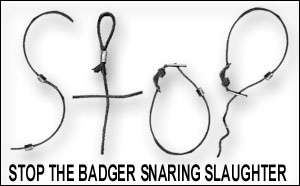
Stop the badger snaring slaughter
An estimated 100,000 badgers have been cruelly snared and killed by the Department of Agriculture since 1984. The assault on this supposedly protected species takes place under licence from the National Parks and Wildlife Service and is part of a so-called bovine TB Eradication Scheme - a failed and discredited operation that has been described as "slaughter masquerading as science".
Bernie Barrett of Badger Watch Ireland describes how badgers suffer under the Department’s scheme: "The method of capture is a barbaric wire snare which holds the helpless badger in excruciating pain until it is dispatched by gunshot. That’s provided the animal has not agonisingly strangled itself beforehand. When nursing female badgers are snared and shot, their cubs are left to starve to death underground."
According to the Irish Wildlife Trust, 6,000 Department of Agriculture snares are set in Ireland every night and there are fears that the species is now endangered. The IWT is opposed to the badger cull and states on its website: "Badgers can die over extended periods struggling in these hideous devices while their young starve underground. Not only is it barbaric and unethical, recent findings have shown it to be ineffective in the war on bovine TB. Nobody has ever counted badgers accurately in this country and while it has always been assumed that they are common animals, this can no longer be taken for granted."

ACTION ALERTS
Sign our petition
Ireland: Stop badger snaring cruelty NOW
Please appeal to Agriculture Minister to show compassion and suspend the cruel badger snaring operation. Remind the Minister that the badger is a protected species in Ireland and that the Animal Health and Welfare Act, for which he is responsible, clearly states: "A person shall not do, or fail to do, anything or cause or permit anything to be done to an animal that causes unnecessary suffering to, or endanger the health or welfare of, an animal". Tell him that research has shown that "badger culling apparently has the capacity to increase badger-to-badger transmission of infection, potentially undermining anticipated reductions in badger-to-cattle transmission."
Minister Simon Coveney
Please write to the Minister for Arts, Heritage and Gaeltacht Affairs and to the National Parks and Wildlife Service. Remind them that the Wildlife Act, for which they are responsible, lists the badger as a protected species. Demand that they stop licensing the snaring and killing of thousands of badgers as part of a cruel and discredited TB eradication scheme.
Minister Jimmy Deenihan
Email: ministers.office@ahg.gov.ie
Constituency Details
Director, Licensing Unit
Slideshows: Badger snaring cruelty
Video Playlist: Badgers
Download an Action Alert Poster
Dail Question to previous Agriculture Minister
Question 451 - Answered on 27th February, 2007
Tony Gregory: To ask the Minister for Agriculture and Food the number of snares laid by her Department officials to snare badgers in 2006; if her Department has received complaints that other wildlife and domestic animals are being caught or injured in these snares; if she will review this practice; and if she will make a statement on the matter.
Ref No: 7116/07. Written reply.
Minister for Agriculture and Food (Mary Coughlan): My Department implements a wildlife strategy, which includes the targeted removal of badgers, under licence issued by the Department of Environment, Heritage and Local Government where they are implicated in an outbreak of TB. Capturing is undertaken in areas where serious outbreaks of Tuberculosis have been identified in cattle herds and where an epidemiological investigation carried out by my Department's Veterinary Inspectorate has found that badgers are the likely source of infection.
Most of the operational work involved is carried out by staff from the Farm Relief Service Co-op (FRS) who are closely supervised by staff from my Department. For this, a "stopped restraint" of a type approved under Section 34(2) of the 1976 Wildlife Act is used. During the peak months (spring/early summer and autumn), each FRS staff person lays and monitors between 60-100 restraints and at peak times there may be up to 6,000 restraints on farmland on a given night. My Department does not have precise figures in relation to the number of restraints set annually. All restraints are checked daily to ensure trapped animals do not suffer any unavoidable trauma. Captured badgers are humanely euthanised.
The landowner's permission is first obtained and landowners adjacent to where capturing operations are ongoing are similarly notified before restraints are set. This ensures that farmed livestock are grazed elsewhere and minimises the risk that domestic animals become accidentally trapped.
The level of non-badger capture is very low and Department staff report 6-8 captures of dogs per year in each county. No complaints have been received by staff of my Department in relation to these captures. Any domestic animals including dogs captured are released unharmed during the morning inspections. Dog owners have a responsibility to confine their animals at night, as dogs should not be roaming freely due to the threats they pose to sheep.
My Department is committed to a research project with UCD on the development of a vaccine for use in badgers that would lead to a reduction in the current high levels of TB infection in that species. It is hoped that this strategy will in the long term reduce the need to cull TB infected badgers as tuberculosis levels falls in both cattle and badgers. However, any vaccine will not be available for wider use in the immediate future and the existing strategy will remain in place for some time.
My Department is satisfied that its current badger removal policy is justified and has contributed to the decline in the number of TB reactors and the costs associated with bovine TB.
Minister Coughlan's response - A translation
The authors of the report advise that "badger culling apparently has the capacity to increase badger-to-badger transmission of infection, potentially undermining anticipated reductions in badger-to-cattle transmission."
Cattle infect badgers with TB: it's official
Statement from Badger Trust (UK)
A major new report published today in the Proceedings of the National Academy of Sciences, the United States’ premier scientific journal, has revealed that cattle rapidly spread bovine TB to badgers [1]. The hugely significant findings mean that by controlling bovine TB in cattle through better TB testing, the prevalence of TB will also be reduced in badgers.
The research, from the Krebs Randomised Badger Culling Trial (RBCT), also confirms that killing badgers increases bovine TB in badger populations, probably by disrupting badgers’ otherwise stable social order and by increasing the amount of contact that badgers have with cattle. This finding means that badger culling has no place in any science-based strategy to control bovine TB.
Significantly, the research has been peer-reviewed by independent, international scientists, so it cannot be undermined by the minority of out-of-touch vets who profess to have a better scientific understanding of the complex dynamics of this disease. The Badger Trust has provided a briefing for journalists to explain the findings.
To download a pdf copy of the report, click here
Commenting on the findings, Badger Trust spokesman Trevor Lawson said: “This research confirms beyond doubt that cattle are the major vectors of bovine TB, readily infecting badgers and other cattle.
“The NFU and other farming lobby groups should now have the courage to call a halt to illegal badger killing and to immediately withdraw their unsupported demands for state-sponsored badger culls.
“Those callous vets who have demanded badger killing should hang their sorry heads in shame. They have undermined public confidence in the veterinary profession’s commitment to animal welfare and severely damaged the profession’s scientific integrity.”
Confirmation that cattle rapidly spread TB to badgers was obtained as the result of another catastrophe created by farmers – foot and mouth disease (FMD). Prior to FMD and in the early stages of badger culling, the prevalence of bovine TB in culled badgers was around five per cent in the RBCT. But when TB testing of cattle stopped during FMD, the disease spread rapidly between cattle within herds. In 2002, the prevalence of TB in badgers shot up to more than 20 per cent and then declined as TB testing removed infected cattle. Careful analysis has ruled out the possibility that the changes occurred due to a suspension of badger culling during FMD.
The authors of the paper, from the Independent Scientific Group, the Veterinary Laboratories Agency and the Central Science Laboratory, advise that:
“Badger culling apparently has the capacity to increase badger-to-badger transmission of infection, potentially undermining anticipated reductions in badger-to-cattle transmission. Likewise, cattle-to-badger transmission appears to be influenced by cattle testing regimes, which suggests that improved cattle controls might not only have immediate benefits through reduced cattle-to-cattle transmission, but could also ultimately reduce the probability of infection from wildlife … It may be helpful…to replace the traditional paradigm of a wildlife ‘reservoir host’ from which infection ‘spills over’ into livestock, with a more dynamic picture, including substantial transmission both within and between alternative host species.”
Photo: Dead badger in Department snare
The following image shows a badger dead in an Irish Department of Agriculture snare. At the base of the tree to which the snare is attached are scratch marks where the badger desperately tried to claw its way to freedom.
For more photos of snares and dead badgers, please visit our Badger Snaring Gallery
Campaign Postcard
Make a donation to ICABS
Please consider making a donation to ICABS. For more details, please click on the button below or
follow this link to find out how to become a campaign supporter. Thank you.
Minister for Agriculture
Department of Agriculture
Agriculture House,
Kildare Street, Dublin 2.
Email: minister@agriculture.gov.ie
Tel: 01-607 2000 or LoCall 1890-200510.
Fax: 01-661 1013.
Minister for Arts, Heritage and Gaeltacht Affairs
23 Kildare Street
Dublin 2
cc: taoiseach@taoiseach.gov.ie
Tel: (01) 631 3804
Fax: (01) 661 1201
18A The Square, Listowel, Co Kerry
Telephone: 068-57446
Fax: 068-57805
National Parks and Wildlife Service
7 Ely Place, Dublin 2
Email: wildlifelicence@ahg.gov.ie
Tel: 01-888 3214

One man and his snared dog: A landowner holds up "Echo", one of his four dogs which were caught in Department of Agriculture snares over a 7-day period (during daylight hours). The traumatised creature was released and is seen here prior to the snare wire being removed from around its body. (Photo: Badger Watch Ireland)

Stop the badger snaring slaughter
View the Poster
Download the Poster
A stopped restraint
A deadly snare
Badgers implicated in an outbreak of TB
Badgers which have TB - possibly caught as a result of contact with infected cattle
Badgers are the likely source of infection
Badgers may very well have got the TB from infected cattle
Staff lay and monitor the restraints
Staff set the snares, leave, and return the next day to shoot the badger.
All restraints are checked daily to ensure trapped animals do not suffer any unavoidable trauma
Badgers caught in the snares are likely to have suffered a night of trauma and may be dead when the Department operative comes to "humanely" kill them
Captured badgers are humanely euthanised
Captured badgers are shot in the head
The landowner's permission is first obtained before restraints are set
A notice sent by Department representatives to farmers (a copy of which was recently seen by ICABS) suggests that permission is requested but that if farmers don't get around to responding, the snarers assume they have permission
The level of non-badger capture is very low
The level of domestic animals caught annually may be as many as 208 across the 26 counties. This is low only when compared to the number of badgers caught in the snares - tens of thousands to date
No complaints have been received by staff of my Department in relation to these captures
A man who contacted ICABS told us that he complained to a badger snarer acting on behalf of the Department after his dog was found caught in one of the snares
Any domestic animals, including dogs, captured are released unharmed
Domestic animals caught are likely to have suffered distress or injury due to the snare
Dog owners have a responsibility to confine their animals at night, as dogs should not be roaming freely due to the threats they pose to sheep
The snares set by the Department are often in place throughout the day time which means that domestic animals are continually at risk
My Department is satisfied that its current badger removal policy is justified
My Department has disregarded widespread, valid criticism of the killing of badgers. The so-called TB Eradication Scheme has been described as "laughable", "slaughter masquerading as science" and based on "voodoo rather than science". A major report published in the Proceedings of the National Academy of Sciences, the premier scientific journal in the US, has revealed that cattle rapidly spread bovine TB to badgers. The research, from the Krebs Randomised Badger Culling Trial, also confirms that killing badgers increases bovine TB in badger populations, probably through disruption of the animals' stable social order, and by increasing the amount of contact badgers have with cattle.
2nd October 2006

Visit www.badgerwatch.ie for news on the campaign against badger snaring
Join our appeal to the Agriculture Minister. Send one of our "Stop the Badger Snaring Slaughter" postcards today. To receive one or more copies, please get in touch with us now.

